








Can I invest in Dubai real estate from India? A practical 2026 guide
Short answer: Yes — Indian individuals can buy property in Dubai from India. Dubai allows non‑UAE nationals to acquire freehold property in government‑designated areas and register title at the Dubai Land Department; Indian residents must follow India’s foreign‑remittance and tax rules when sending money and reporting the asset. Below is a practical, up‑to‑date (2026) guide covering the legal entry points, costs, financing, tax implications, market data and clear next steps.
Who can buy, and where: legal basics
Foreign nationals, including Indian citizens, are permitted to buy real estate on a 100% freehold basis in Dubai only in areas designated as freehold by Dubai authorities. You do not need a UAE residence visa to buy property; title is registered in your name at the Dubai Land Department (DLD). Use DLD records or the project’s title deed (Oqood/title) to confirm an asset is in a freehold area before you sign. (jre.ae)
Key costs & charges you must budget for
Major recurring and one‑off costs to plan for include:
- Dubai Land Department (DLD) transfer/registration fee — typically 4% of the sale price (paid at transfer), plus modest administrative/trustee fees and NOC charges. Plan about 4–6% extra for typical transaction costs overall unless the developer offers a fee waiver. (propertyfinder.ae)
- Mortgage registration and trustee fees if you finance the purchase (mortgage registration is a small percentage plus fixed admin fees). (joinoliva.com)
- Ongoing costs: service charges/maintenance for the building/community, property management (if you let the unit), insurance and periodic vacancy. These reduce net yield versus gross rent.
Financing from India / in the UAE — what to expect
Financing options differ depending on whether you get a mortgage from a UAE bank or fund the purchase from India. UAE banks lend to expatriates and some non‑residents, but central bank rules set maximum loan‑to‑value (LTV) limits that vary by buyer type and property value — expat borrowers commonly face lower LTVs than UAE nationals and non‑resident or second‑property loans require larger deposits. Expect to provide a meaningful down payment (often 20–40% or more depending on your profile and whether you are non‑resident). Confirm lender policy early. (rulebook.centralbank.ae)
Cross‑border money movement & Indian rules
Indian residents sending money to buy property abroad must comply with RBI/FEMA rules. Under the Liberalised Remittance Scheme (LRS) an individual resident can remit up to USD 250,000 per financial year (April–March) for permitted capital/current account transactions (including purchase of immovable property abroad). Work with your authorised dealer bank (your branch) to ensure correct declarations and documentary compliance. (rbi.org.in)
Tax implications — UAE and India (brief, practical)
UAE: There is no federal personal income tax or personal capital‑gains tax in the UAE for individuals, which is one reason many foreign buyers find Dubai attractive. However, UAE corporate tax and VAT rules still apply to businesses and certain transactions. (en-ae.tkegexpat.com)
India: An Indian tax resident is taxable on global income and must disclose foreign assets and income in the ITR (Schedule FA). Capital gains on sale of an overseas property and rental income earned abroad are taxable in India (subject to DTAA/foreign tax credit rules where relevant). Work with an Indian chartered accountant to record Form 67/44 (if claiming foreign tax credit), to avoid disclosure failures, and to compute capital‑gains correctly. (taxoneadvisory.com)
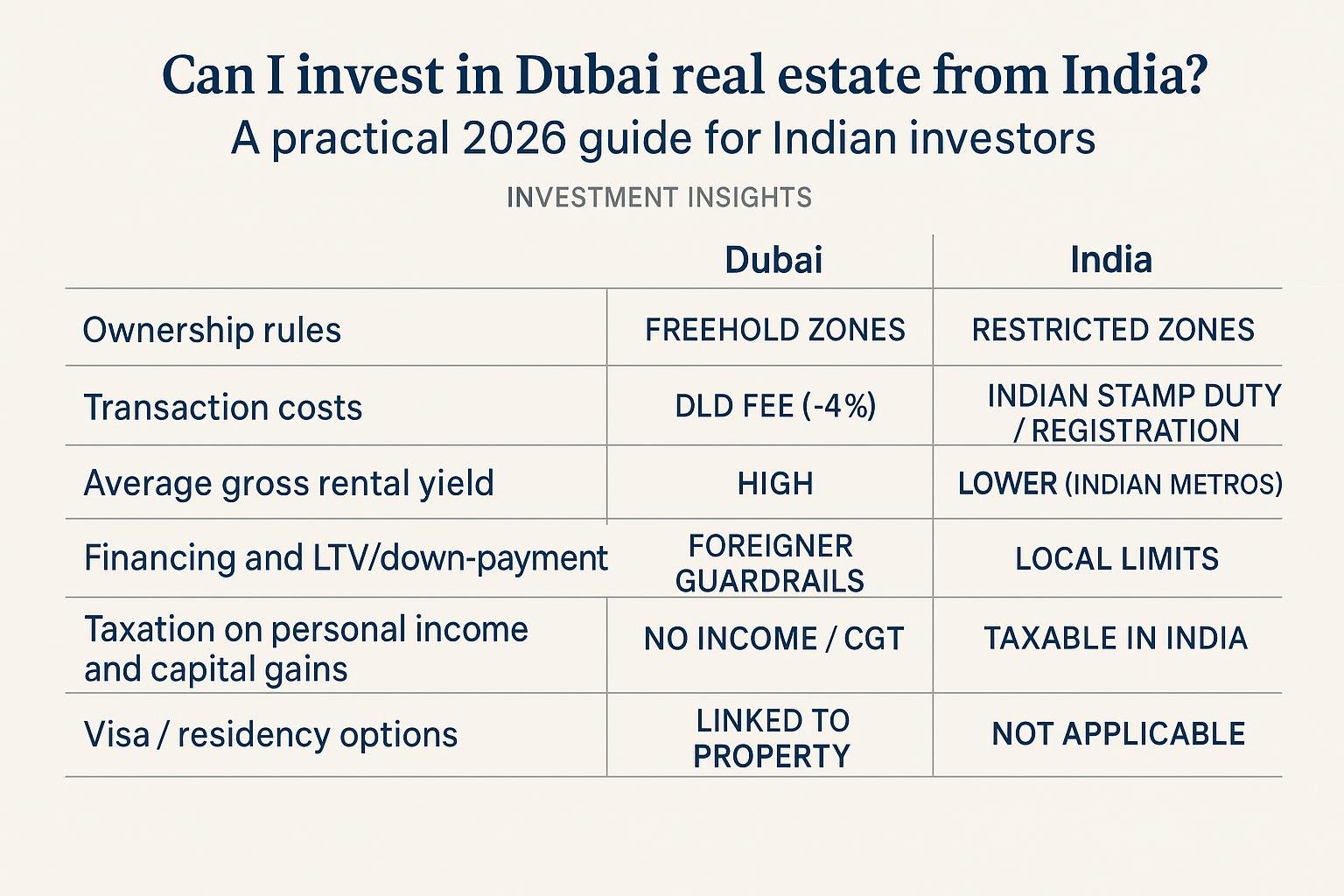
Market data comparison / Data snapshot
Snapshot (date‑tagged figures): Dubai’s residential market recorded strong price growth through 2024–2025 and into early 2026; independent indices reported double‑digit annual gains in 2025 (for example, a ValuStrat index reading showed ~23.9% YoY gain for mid‑2025 in some series) while city‑wide average gross rental yields are commonly cited around 6–7% (apartment yields higher than villas). By contrast, major Indian metros typically show lower gross rental yields (commonly ~2–4% in Mumbai/Delhi prime locations, higher in some tier‑2 cities). These are market averages — your result depends on location, unit type and management. (valustrat.com)
| Comparison point | Dubai (typical) | India — major metro (example: Mumbai) |
|---|---|---|
| Ownership for foreigners | Freehold in designated areas; title registered with DLD. | Foreign nationals cannot directly own residential property in India (different rules apply); NRIs/PIOs have separate provisions. |
| Transaction fee | DLD transfer ~4% of sale price + admin/trustee fees (typical total 4–6%). (propertyfinder.ae) | Stamp duty and registration vary by state (often 4–10%+ depending on state). |
| Average gross rental yield | ~6–7% city average for apartments (varies by community). (propertywiki.ai) | ~2–4% in prime Mumbai; some tier‑2 cities can be higher. (apnacalculator.com) |
| Financing | UAE banks lend to expats; LTV caps set by Central Bank (expats often 70–80% for first property, non‑residents lower). (rulebook.centralbank.ae) | Indian banks offer home loans to NRIs/PIOs; resident buyers use domestic lenders with familiar documentation. |
| Tax on personal income/capital gains | No personal income tax/capital gains tax in UAE (individuals). (en-ae.tkegexpat.com) | India taxes residents on global income — foreign rental/capital gains are reportable and taxable (with FTC/DTAA where applicable). (taxoneadvisory.com) |
| Visa options tied to property | Property routes exist (e.g., 10‑year Golden Visa via AED 2,000,000 property threshold; shorter investor visas also available with changing thresholds). Check DLD/GDRFA for current rules. (astraterra.ae) | Not applicable. |
Practical next steps (step‑by‑step checklist)
1) Decide strategy: buy for capital growth, buy‑to‑let (income), or buy for residency (Golden Visa). Each requires different budget, risk tolerance and time horizon.
2) Verify a project’s title and freehold status via DLD records and request the developer’s Oqood/title documents. Insist on seeing the DLD‑registered title and any mortgage/NOC details. (jre.ae)
3) Budget fully: purchase price + ~4% DLD transfer + mortgage registration/admin fees + 1–3% broker/legal + 5–10% contingency for holding/management costs until rented/sold. (propertyfinder.ae)
4) Check funding: can you remit under RBI LRS (USD 250,000 per FY) or will you use staged payments/multiple years? Confirm bank documentation required (A2 form, source of funds, PAN, etc.) with your authorised dealer bank. (rbi.org.in)
5) Speak to a UAE mortgage lender early if you plan to finance; request a pre‑approval and bank checklist to understand LTV, income proofs and down‑payment expectations. (astraterra.ae)
6) Engage professionals: a Dubai‑licensed RERA agent, a UAE real‑estate lawyer for SPA and transfer, and an Indian CA/tax advisor for remittance and reporting (ITR Schedule FA, Form 67 for FTC if relevant). This reduces execution and tax risk. (taxoneadvisory.com)
FAQ
Q: Do I need to be a UAE resident to buy?
A: No — you can buy without a UAE residency visa if the property is in a designated freehold area and you follow DLD procedures. (jre.ae)
Q: How much can I remit from India to buy?
A: Under RBI’s LRS, resident individuals can remit up to USD 250,000 per financial year for permitted purposes, including overseas property purchase; coordinate with your bank for documentary requirements. (rbi.org.in)
Q: Will I pay capital gains tax in UAE or India on resale?
A: The UAE does not tax personal capital gains; however, as an Indian tax resident you must report and may be taxed in India on gains from sale of foreign property — seek local tax advice and claim foreign tax credit where permitted. (en-ae.tkegexpat.com)
Q: Can buying property get me a UAE visa?
A: Yes — the UAE has property‑linked investor residency pathways (including a 10‑year Golden Visa with an AED 2,000,000 property‑value threshold at the time of writing), but rules and valuations change, so confirm current DLD/GDRFA criteria before assuming visa eligibility. (astraterra.ae)
Data snapshot for quick reference
– DLD transfer fee: ~4% of sale price (paid at transfer). (propertyfinder.ae)
– Dubai average gross apartment yield (2025–Q1 2026 range): roughly 6–7% (community dependent). (propertywiki.ai)
– RBI LRS outward remittance limit: USD 250,000 per financial year (resident individual). (rbi.org.in)
– UAE personal income tax: none for individuals (no personal income tax / no personal capital gains tax in typical cases). (en-ae.tkegexpat.com)
Final note: Dubai offers a transparent, well‑documented route for foreign property buyers and attractive gross yields versus many global cities — but cross‑border investment needs careful structuring to meet RBI/FEMA rules and Indian tax reporting. Always confirm the latest visa, DLD, and bank lending rules at the point you act and work with qualified advisers in both India and the UAE.
Want help with this Dubai property question?
Share your goal, budget, and preferred area. Real Dubai Deals can help you understand the next practical step.