





Dubai golden visa property investment 2026 is on its strongest trajectory yet: 4,218 investors secured UAE residency through real estate purchases in Q1 2026 alone — a 34.7% year-on-year surge that makes property the fastest-growing residency pathway in the emirate. The AED 2 million threshold for the 10-year Golden Visa has held steady since 2022, but the strategic landscape around it has evolved considerably. Off-plan purchases now explicitly qualify. Combined-portfolio rules have been clarified by the Dubai Land Department. And an increasingly sophisticated cohort of buyers is using the Golden Visa not merely as a residency stamp but as the anchor of a dual-purpose strategy: long-term UAE residency paired with a high-yield or high-appreciation real estate position. This guide is for the investor who has decided the Golden Visa is worth pursuing and wants to know exactly where to buy, what to buy, and how to structure the investment to maximise both qualification and financial returns in 2026.
- Why Dubai Golden Visa Property Investment 2026 Is Surging
- AED 750K vs AED 2M: Choosing the Right Investment Threshold
- Best Areas for Dubai Golden Visa Property Investment in 2026
- Property Types That Qualify: Apartments, Villas, Off-Plan, and Combined Portfolios
- Maximising Returns on Your Dubai Golden Visa Property Investment 2026
- Hidden Costs and Tax Efficiency: What Golden Visa Investors Actually Pay
- Blue Visa vs Golden Visa: Dubai’s 2026 Long-Term Residency Tiers Compared
- Frequently Asked Questions
Why Dubai Golden Visa Property Investment 2026 Is Surging
The numbers are unambiguous. Dubai Land Department data for Q1 2026 shows 4,218 residency approvals issued through real estate investment — a 34.7% increase on the same quarter in 2025. Total foreign property investment in the emirate reached AED 148.35 billion in Q1, with foreign investors accounting for 59% of all transactions by value. These two data points reinforce each other: foreign capital is flowing in at record rates, and a material proportion of it is explicitly structured around Golden Visa qualification.
Three forces are driving the acceleration. First, Dubai’s tax environment has become increasingly differentiated from competitor jurisdictions. Zero income tax, zero capital gains tax on property, zero inheritance tax — and now, with the UAE’s 9% corporate tax applying only to businesses earning above AED 375,000 per year, high-net-worth individuals find Dubai’s fiscal framework more compelling in 2026 than at any previous point. The Golden Visa converts that tax advantage from a tourist benefit into a permanent residential status.
Second, global mobility conditions have deteriorated across multiple jurisdictions. Visa friction from the UK, EU, and US — for nationals of India, Russia, Nigeria, Pakistan, and dozens of other countries — has made the UAE’s relatively streamlined Golden Visa an attractive hedge. For investors who need a second-home base and a functioning visa travel document, a UAE Golden Visa linked to a real AED 2 million property is a meaningful asset.
Third, the Dubai property market itself has validated the investment. According to Gulf News, the combination of strong capital appreciation (villas up 35.3% year-on-year in Q1 2026), robust rental yields (6–8.5% across most qualifying price points), and long-term residency makes the AED 2 million threshold feel less like a cost of entry and more like a well-structured investment with a residency benefit attached. Our Q1 2026 Dubai property market analysis breaks down exactly which areas and property types are driving the strongest returns this year.
AED 750K vs AED 2M: Choosing the Right Investment Threshold
One of the most common points of confusion for international buyers is the relationship between Dubai’s two property-linked residency tiers. They operate differently in terms of visa duration, renewal requirements, and family inclusion rights. Here is a direct comparison:
| Feature | AED 750K Investor Visa | AED 2M Golden Visa (10-year) |
|---|---|---|
| Visa duration | 2 years (renewable) | 10 years (renewable) |
| Minimum property value | AED 750,000 (DLD-registered) | AED 2,000,000 (DLD-registered) |
| Mortgaged property eligible? | Yes, if equity ≥ AED 750K | Yes, if total value ≥ AED 2M |
| Off-plan eligible? | No — must be completed, title deed issued | Yes — from approved developers; Oqood registration accepted |
| Multiple properties allowed? | Yes — combined DLD value counts | Yes — combined DLD value counts |
| Spouse and children included? | Yes (separate applications) | Yes (included in same application) |
| Sponsor required? | No | No |
| Minimum stay requirement? | Must not remain outside UAE more than 6 months continuously | No minimum stay; visa does not lapse with absence |
| Work permit included? | No (separate employment visa required) | Yes — Golden Visa holders may sponsor their own employment |
The most consequential difference is the minimum-stay clause. The 2-year investor visa lapses if you remain outside the UAE for more than six continuous months. The 10-year Golden Visa carries no such restriction — holders can base themselves in another country for years without losing their UAE residency status. For part-time Dubai residents who maintain primary residences elsewhere, this distinction is decisive. Almost all serious investors targeting long-term UAE residency should structure their purchase to meet the AED 2 million threshold specifically for the Golden Visa, not the 2-year investor visa.
For a detailed walkthrough of the application process — documents required, the GDRFA submission portal, and the Emirates ID issuance sequence — see our full Dubai Golden Visa application guide.
Best Areas for Dubai Golden Visa Property Investment in 2026
The strategic question for Dubai golden visa property investment 2026 is not simply which areas are cheapest at the AED 2 million threshold — it is which areas offer the strongest combination of visa eligibility, rental yield, capital appreciation, and exit liquidity at that entry point. The table below maps the key communities against these metrics:
| Area | Min Qualifying Unit (AED 2M+) | Typical Unit Type | Gross Yield | Price Appreciation (2020–2026) | Liquidity |
|---|---|---|---|---|---|
| Business Bay | 2.0M–2.3M | 1BR–2BR apartment | 5.5–7.0% | ~65% | Very High |
| Dubai Marina | 2.1M–2.8M | 1BR–2BR apartment | 5.0–6.5% | ~72% | Very High |
| Downtown Dubai | 2.2M–3.5M | 1BR apartment | 4.5–6.0% | ~75% | High |
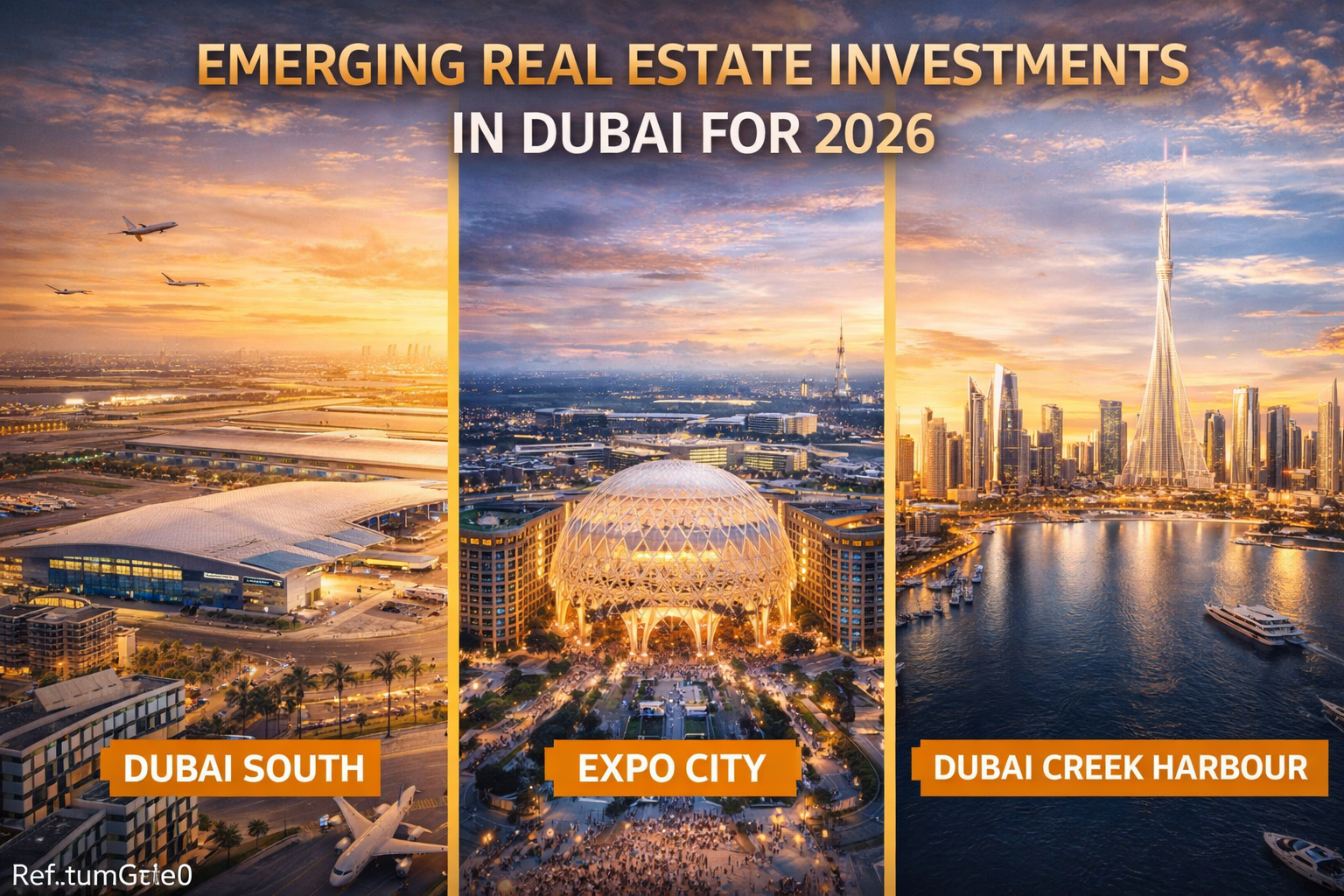
| Dubai Creek Harbour | 2.0M–2.8M | 2BR apartment | 6.0–8.0% | ~60% (newer area) | High |
| Dubai Hills Estate | 2.0M–3.2M | 2BR–3BR apartment / townhouse | 5.0–6.5% | ~80% | High |
| Jumeirah Village Circle | 2.0M–2.5M (2BR–3BR) | 2BR–3BR apartment | 6.5–7.5% | ~75% | Very High |
| Mohammed Bin Rashid City | 2.0M–4.5M | 2BR apartment / townhouse | 5.0–6.5% | ~70% | High |
| Palm Jumeirah | 3.5M–9M+ | 1BR–2BR apartment | 4.0–5.5% | ~110% | High |
The sweet spot for dual-purpose Golden Visa + yield investment in 2026 sits in Business Bay, Dubai Creek Harbour, and the upper range of Jumeirah Village Circle. These three areas offer qualifying units at or just above the AED 2 million threshold, gross yields of 6–8%, strong secondary-market liquidity, and access to a deep tenant pool of professionals and expatriate families. Downtown Dubai and Dubai Marina are also strong performers but offer lower yields at the AED 2 million entry point — a trade-off that makes sense for buyers who weight capital appreciation over running income.
Palm Jumeirah, while the most prestigious address, typically requires AED 3.5 million or more for a qualifying apartment unit. For buyers targeting Golden Visa qualification specifically, paying a premium for the Palm Jumeirah address is optional — but investors with a 7–10 year hold horizon who believe in continued luxury appreciation may find the higher entry justified by the outsized capital gain track record.
Property Types That Qualify: Apartments, Villas, Off-Plan, and Combined Portfolios
Not all property configurations qualify equally for Dubai golden visa property investment 2026. The Dubai Land Department’s eligibility rules cover four distinct acquisition structures, and understanding each one opens up strategic options that many buyers miss.
Ready apartments and villas. The baseline case. A completed freehold property in a designated zone with a DLD-registered title deed and a purchase price at or above the applicable threshold. This is the fastest path to visa application — the title deed can be submitted directly to GDRFA or ICP within days of DLD registration. No additional developer or valuation steps required beyond the DLD valuation report.
Off-plan property from approved developers. As of 2024, the DLD confirmed that off-plan units purchased from RERA-registered developers at AED 2 million or above qualify for the Golden Visa through an Oqood (off-plan registration) rather than a title deed. This is a significant expansion of the programme. Buyers committing to a qualifying off-plan project can initiate the visa application process from the time of Oqood registration, well before handover. The practical implication: investors entering off-plan in 2026 at below-market launch prices can lock in Golden Visa eligibility at a lower effective cost than buying at secondary-market prices post-completion.
Mortgaged properties. A mortgaged property qualifies for the 10-year Golden Visa provided the total DLD-registered value of the property meets the AED 2 million threshold — regardless of how much of the purchase price was financed. An investor who puts AED 500,000 down on a AED 2.5 million property and finances the remaining AED 2 million through a UAE bank is eligible from the day of DLD title deed registration. The bank holds the mortgage as a charge on the title, not as ownership — the buyer remains the registered DLD owner and qualifies accordingly.
Combined portfolios (multiple properties). Investors who hold multiple smaller properties can combine their DLD-registered values to meet the AED 2 million threshold. Two AED 1.1 million apartments in different areas but both registered to the same buyer create a combined DLD value of AED 2.2 million — sufficient for the 10-year Golden Visa. This rule opens the Golden Visa to investors who entered the market at lower price points and now hold a portfolio with combined value above the threshold, even if no individual unit qualifies on its own. The combined-portfolio route requires a DLD portfolio valuation certificate rather than individual title deeds.
Before committing to any off-plan project as part of a Golden Visa-qualifying purchase, it is worth working through the full due diligence checklist. Our 18-parameter off-plan de-risk guide covers developer track record, RERA escrow compliance, and payment plan structure — all directly applicable to Golden Visa off-plan purchases where your residency timeline depends on project delivery.
Maximising Returns on Your Dubai Golden Visa Property Investment 2026
The most sophisticated Dubai golden visa property investment 2026 strategies treat the AED 2 million not as a visa fee but as a capital deployment decision that happens to unlock residency as a secondary benefit. Here is how to structure the investment to optimise both.
Strategy 1: Maximum yield at minimum threshold. Target a 2-bedroom apartment in JVC, Business Bay, or Dubai Creek Harbour at exactly AED 2.0–2.1 million. These units currently deliver 6.5–8% gross yield — the highest available at the Golden Visa entry point. Annual rental income of AED 130,000–168,000 on a AED 2 million investment represents a compelling cash-flow yield regardless of any residency benefit. This is the right approach for investors whose primary objective is income generation, with Golden Visa as the added bonus.
Strategy 2: Capital appreciation focus. Stretch entry to AED 2.5–3.5 million in Dubai Marina, Downtown, or Dubai Hills Estate. Yields will compress to 5–6.5%, but you are buying into communities with 65–80% appreciation since 2020 and deeper institutional buyer pools at exit. The capital gain on resale in these areas has outperformed the yield advantage of cheaper alternatives on a total return basis across every 5-year hold period since 2016.
Strategy 3: Off-plan entry below secondary-market pricing. Select a qualifying off-plan project at AED 2 million or above, typically at 15–25% below the projected post-handover value. The Golden Visa application proceeds immediately via Oqood registration. At handover, the property is worth materially more than purchase price — and the investor has held UAE residency throughout the construction period. This is the highest-upside structure for investors with a 3–5 year horizon and an appetite for off-plan execution risk.
Strategy 4: Portfolio combination for existing investors. If you already hold Dubai property with a combined DLD value approaching AED 2 million, adding a targeted acquisition to push the portfolio over the threshold may be the most capital-efficient path to the Golden Visa. Rather than deploying a full fresh AED 2 million, you add only the incremental value needed — potentially as little as AED 300,000–500,000 — to achieve qualification via the combined-portfolio route.
For investors considering mortgage financing as part of their Golden Visa purchase strategy, the key calculation is ensuring the total DLD-registered property value — not just the equity contributed — reaches AED 2 million. A 25% down payment (AED 500,000) on a AED 2 million purchase is sufficient for Golden Visa qualification because the full AED 2 million is the registered title value.
Hidden Costs and Tax Efficiency: What Golden Visa Investors Actually Pay
The full cost of a Dubai golden visa property investment in 2026 extends beyond the AED 2 million property price. Investors should budget for the following additional costs:
Property acquisition costs (payable at DLD registration): 4% DLD transfer fee (AED 80,000 on a AED 2M purchase) + AED 4,000 registration fee + AED 250–580 admin/knowledge fee + 2% agent commission if a secondary-market purchase (AED 42,000 including VAT). Total acquisition transaction cost: approximately AED 126,000–130,000 on a AED 2 million purchase, or roughly 6.3–6.5% of the purchase price.
Golden Visa application fees: The Dubai Land Department Golden Visa application involves a DLD valuation report fee (AED 4,000–6,000), GDRFA or ICP application fees (approximately AED 3,500–5,000), medical fitness test and Emirates ID biometrics (AED 1,000–1,500), and the visa issuance fee itself (AED 1,150 for 10-year). Total government and administrative fees for the Golden Visa application: approximately AED 10,000–14,000 per primary applicant, with an additional AED 8,000–12,000 per dependent family member included on the same application.
Ongoing property costs: Annual service charges range from AED 5–40 per sqft depending on community and building. A 1,200 sqft apartment in Business Bay carries approximately AED 18,000–24,000 per year in service fees. DEWA utility connection (AED 2,000–4,000 refundable deposit) is payable once. There is no annual property tax in Dubai — zero.
The tax efficiency of the UAE Golden Visa is exceptional: holding Dubai real estate as a UAE Golden Visa resident means zero income tax on rental income, zero capital gains tax on resale proceeds, and zero inheritance tax on UAE-held assets. For investors from high-tax jurisdictions (UK, France, Germany, India, Australia), the lifetime tax saving that flows from establishing genuine UAE residency — which the Golden Visa facilitates — can far exceed the investment threshold itself. According to the UAE Government’s official Golden Visa portal, holders are treated as UAE residents for all purposes including tax treaty benefits.
Blue Visa vs Golden Visa: Dubai’s 2026 Long-Term Residency Tiers Compared
A significant development that investors evaluating the Dubai golden visa property investment 2026 route should understand is the introduction of the UAE Blue Visa — a newer long-term residency category aimed at environmental pioneers, climate scientists, and sustainability advocates. It is not a property-linked visa and is not directly relevant to real estate investors, but its existence confirms that the UAE is actively expanding its long-term residency architecture beyond the traditional Golden Visa framework.
For property investors, the relevant comparison remains between the 2-year investor visa (AED 750K threshold) and the 10-year Golden Visa (AED 2M threshold). As analysed above, the Golden Visa’s absence of a minimum-stay requirement and its inclusion of dependent family on the primary application make it structurally superior for almost all investor profiles. The AED 1.25 million incremental investment required to upgrade from the 2-year to the 10-year visa delivers 8 additional years of no-condition residency, work permit rights, and family inclusion — a compelling value proposition at Dubai’s current property price levels.
The broader takeaway from Dubai’s expanding residency menu is that the emirate is deliberately deepening its appeal as a permanent or semi-permanent residence destination for global talent and capital — not merely a transit or tourism hub. Each new visa tier reinforces the structural demand for qualifying real estate. Golden Visa investors are, in effect, buying into a policy commitment as well as a property market.
Frequently Asked Questions
Does an off-plan property qualify for the Dubai Golden Visa in 2026?
Yes. Off-plan properties purchased from RERA-registered developers at a purchase price of AED 2 million or above qualify for the 10-year Golden Visa through Oqood (off-plan DLD registration) rather than a completed title deed. The visa application can be initiated from the Oqood registration date, meaning investors can begin the Golden Visa process during the construction period rather than waiting for handover. Confirm developer RERA registration and project escrow account compliance before proceeding.
Can I combine multiple Dubai properties to reach the AED 2 million Golden Visa threshold?
Yes. The Dubai Land Department’s combined-portfolio rule allows investors to aggregate the DLD-registered values of multiple freehold properties in their name to meet the AED 2 million threshold, even if no individual property qualifies on its own. A DLD portfolio valuation certificate is required as part of the Golden Visa application. All properties in the portfolio must be freehold, in designated zones, and registered solely in the applicant’s name (not shared ownership).
Which Dubai areas offer the best return for a Golden Visa qualifying investment in 2026?
For income-focused investors at the AED 2 million entry point, Business Bay (5.5–7% gross yield), Dubai Creek Harbour (6–8%), and the upper JVC price band (6.5–7.5% for 2BR and 3BR units) offer the strongest income returns while meeting the visa threshold. For capital appreciation-focused buyers, Downtown Dubai, Dubai Marina, and Dubai Hills Estate have demonstrated 65–80% appreciation since 2020 at entry points of AED 2.1–3.5 million, with strong secondary market liquidity at exit.
Does my Golden Visa lapse if I spend most of the year outside Dubai?
No. The 10-year UAE Golden Visa carries no minimum-stay requirement. Holders can reside primarily outside the UAE for extended periods without the visa lapsing, provided the qualifying property remains registered in their name at the required value. This is a fundamental distinction from the 2-year investor visa, which lapses after 6 continuous months outside the UAE. For part-time Dubai residents and global nomads, the Golden Visa’s absence of a stay requirement is one of its most attractive features.
Can my spouse and children be included on my Dubai Golden Visa application?
Yes. The 10-year Golden Visa allows the primary holder to sponsor dependent family members — spouse and children — on the same application, without requiring separate investment or income thresholds for each family member. Each dependent pays their own individual application, medical, and Emirates ID fees (approximately AED 8,000–12,000 per person), but no additional property investment is required. Dependent children up to the age of 25 (and unmarried daughters of any age) are eligible. Parents of the primary holder can also be sponsored separately under standard UAE family sponsorship rules.
Conclusion
Dubai golden visa property investment 2026 has matured into one of the most strategically compelling dual-purpose investment structures available in global real estate. With 4,218 residency approvals granted via property in Q1 2026 alone — a 34.7% year-on-year increase — the market has clearly validated the combination of long-term UAE residency and high-yield, capital-appreciating real estate. Whether you enter at the AED 2 million minimum through a Business Bay apartment or a JVC combined portfolio, or stretch to AED 3.5 million for a Dubai Marina position with stronger capital growth credentials, the Golden Visa transforms what would otherwise be a straightforward property purchase into a lifetime asset: a tax-efficient investment position anchored by 10-year renewable UAE residency. Ready to identify the right qualifying property for your situation? Contact the Real Dubai Deals team for a personalised consultation tailored to your investment goals and residency requirements.