




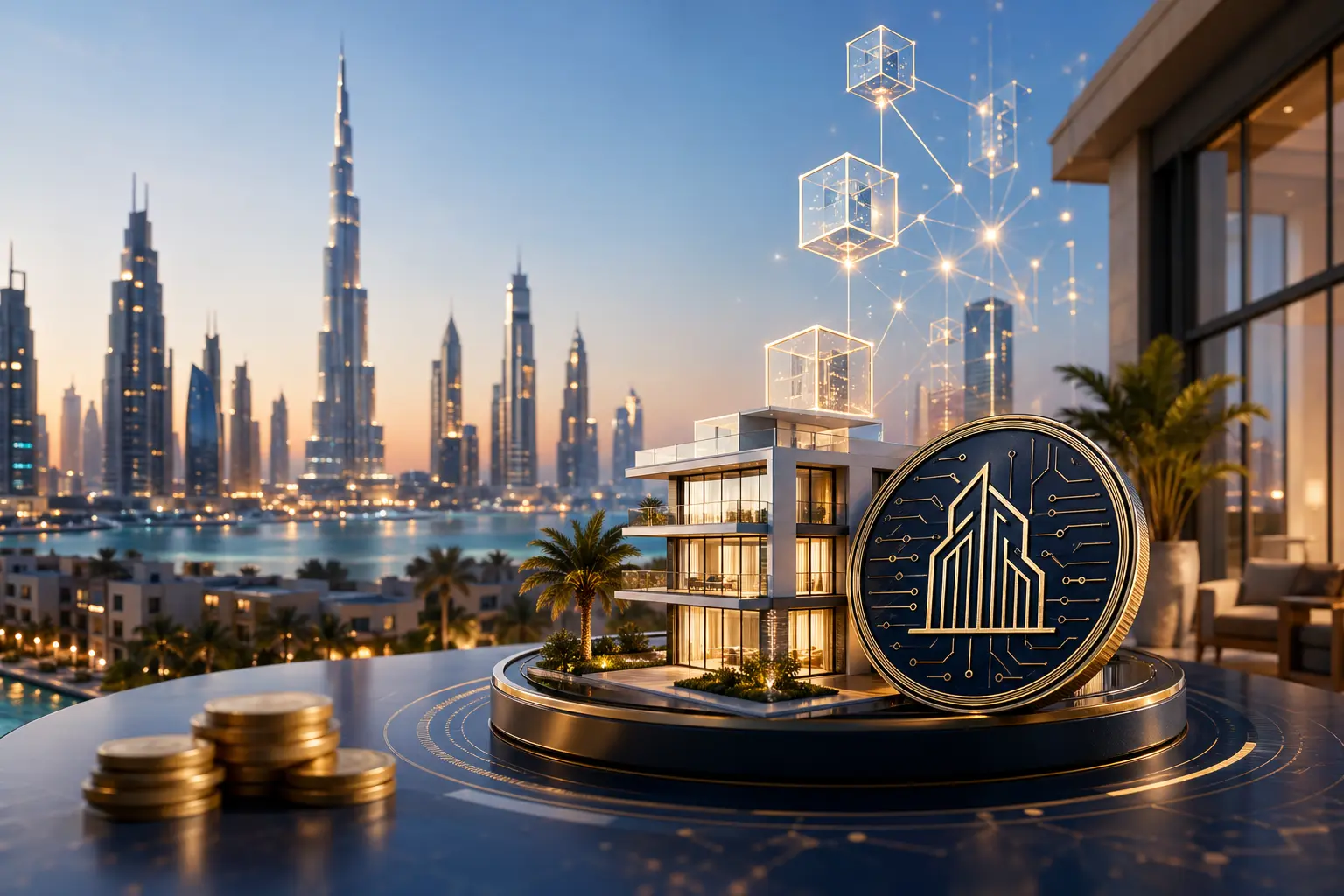
Dubai property tokenization 2026 has moved from concept to reality, with the Dubai Land Department (DLD) activating a live secondary market for blockchain-based real estate tokens on 20 February 2026. For the first time in the region, individual investors can own a legally recognised fraction of a ready Dubai property from as little as AED 2,000, with the title-deed backing enforced directly by the DLD on the XRP Ledger. This guide unpacks exactly how Dubai property tokenization 2026 works, what returns and risks to expect, how to participate as a UAE resident, and whether this new asset class belongs in your portfolio alongside traditional freehold ownership.
Table of Contents
- What Is Dubai Property Tokenization?
- The DLD Blockchain Framework: How It Actually Works
- Dubai Property Tokenization 2026 by the Numbers
- How to Invest in Tokenized Dubai Real Estate: Step-by-Step
- Returns & Risks: Tokenization vs Traditional Freehold Ownership
- Who Should (and Shouldn’t) Buy Tokenized Property
- Frequently Asked Questions
What Is Dubai Property Tokenization?
Dubai property tokenization is the process of representing legal ownership rights in a physical Dubai property as digital tokens on a blockchain, where each token corresponds to a verifiable fraction of the underlying title deed. Unlike informal fractional schemes that rely on a company structure or trust, the DLD’s framework embeds the fractional ownership record directly into the Dubai land registry, meaning every token holder’s share is enforceable as a property right rather than a contractual claim against a fund manager.
The Real Estate Evolution Space Initiative (REES) — the policy backbone of Dubai property tokenization 2026 — was formalised with the launch of a pilot platform in May 2025, followed by Phase 2 activation (secondary trading) on 20 February 2026. Phase 2 transformed tokenized real estate from a buy-and-hold instrument into a tradeable asset with on-chain settlement, taking Dubai ahead of every other major global real-estate jurisdiction on this specific use case.
The immediate result: a retail investor with AED 2,000 can now buy exposure to a ready apartment in Dubai Marina, Downtown or Business Bay and collect a pro-rata share of rental income and capital appreciation — without ever taking on a mortgage, paying transfer fees of 4%, or locking up capital in a single indivisible asset.
The DLD Blockchain Framework: How It Actually Works
The architecture behind Dubai property tokenization 2026 is deliberately conservative. Rather than allow free-floating crypto-native ownership tokens, the DLD chose the XRP Ledger as its settlement layer and partnered with Ripple Custody for institutional-grade token holding. Every token minted is backed 1:1 by a registered ownership fraction recorded in the land registry.
The ownership workflow runs as follows. First, a property is selected by a DLD-licensed tokenization platform and fully vetted — valuation, title verification, structural and service-charge audits. Second, the property is divided into a fixed number of tokens (typically 10,000 or 100,000 units per property). Third, each token purchase is mirrored on the Dubai land registry so the DLD holds the definitive ownership record. Fourth, rental income flows into a regulated escrow account and is distributed on-chain pro-rata to token holders, usually monthly.
A crucial constraint: no single investor can hold more than 20% of the tokens in a given property. This prevents concentration, preserves the retail-democratisation goal of the programme, and keeps any one token holder from claiming management control over the asset. Phase 2 added secondary trading — allowing tokens to change hands on a controlled marketplace — with every trade synced back to the DLD’s registry in real time.
The same standards that apply to a physical title deed apply to tokenized ownership: RERA licensing for the platform, mandatory KYC for investors, and AML checks on every onboarding. This is the opposite of a decentralised crypto project — it is a government-backed, regulator-enforced, blockchain-settled version of conventional property ownership.
Dubai Property Tokenization 2026 by the Numbers
The scale of Dubai property tokenization 2026 is still small relative to the headline property market (Dubai did AED 251.4 billion in Q1 2026 transactions alone), but the trajectory is steep. The table below summarises the current state of the market and the DLD’s forward targets.
| Metric | Value (as of Q1 2026) | Source / Notes |
|---|---|---|
| Secondary market launch date | 20 February 2026 | DLD / Ripple announcement |
| Tokens in circulation | ~7.8 million | Across pilot-phase properties |
| Tokenized property value (live) | Over AED 18 million | > USD 5 million in market cap |
| Minimum ticket size | AED 2,000 | Per token / purchase |
| Maximum stake per investor | 20% per property | DLD concentration rule |
| Eligibility (Phase 2) | UAE residents, 18+, valid Emirates ID | Non-residents in next expansion |
| 2033 tokenization target | AED 60 billion in tokenized assets | ~7% of total property market |
| Broader REES initiative value | USD 16 billion | Digital infrastructure programme |
The AED 60 billion 2033 target implies a compound growth pace that most global real-estate-tokenization markets cannot match — largely because Dubai has solved the single hardest technical problem (the land-registry integration) up front. For a deeper analysis of how the headline market performed in parallel, see our Dubai property market Q1 2026 data breakdown, which covers villa vs apartment dynamics, the golden triangle effect, and mortgage-lending surge.
How to Invest in Tokenized Dubai Real Estate: Step-by-Step
Investing via Dubai property tokenization 2026 is far simpler than buying a freehold apartment, but it still requires meeting eligibility rules and choosing platforms carefully. Here is the current process for Phase 2 (UAE residents only).
Step 1 — Verify your eligibility. You must be a UAE resident aged 18 or above with a valid Emirates ID. Residency includes Golden Visa, employment, investor and family visas. Tourists and overseas investors cannot participate yet (expansion to non-residents is on the DLD roadmap for 2026–2027).
Step 2 — Choose a DLD-licensed tokenization platform. Only platforms authorised by the DLD under the REES framework can mint and distribute tokens that are recognised in the land registry. Do not confuse these with offshore real-estate NFT projects — those typically carry no legal ownership rights in Dubai.
Step 3 — Complete KYC/AML onboarding. You will need to upload your Emirates ID, proof of address, source-of-funds documentation, and typically a short risk-assessment questionnaire. Onboarding usually takes 24–72 hours.
Step 4 — Select a property and buy tokens. Platforms display the underlying property, its location, the number of tokens issued, the current token price, projected rental yield, and audited service-charge history. Purchases are usually funded by AED bank transfer or stablecoin deposit, with a minimum ticket of AED 2,000.
Step 5 — Receive rental distributions and track on-chain. Once the property is fully funded and tenanted, rental income is distributed monthly in AED (or a pegged stablecoin) pro-rata to your token holding. Each distribution event is on-chain and auditable.
Step 6 — Sell on the secondary market (or hold to exit). From 20 February 2026, tokens can be listed on the regulated secondary market at a price of your choosing, subject to the 20%-per-investor concentration cap. Alternatively, investors can hold to a scheduled platform-level exit, where the underlying property is sold and proceeds are distributed.
New investors planning meaningful exposure to Dubai real estate — tokenized or traditional — should still review the fundamentals of market selection and risk. Our 18-parameter off-plan de-risk framework works equally well for screening the underlying assets in tokenization platforms.
Returns & Risks: Tokenization vs Traditional Freehold Ownership
Dubai property tokenization 2026 is not a replacement for freehold ownership — it is a complementary tool that solves different problems. The table below compares the two across the dimensions that matter most to investors.
| Dimension | Tokenized Property | Traditional Freehold |
|---|---|---|
| Minimum investment | AED 2,000 | AED 500,000+ (entry-level apartments) |
| Acquisition costs | 0.5%–2% platform fee | 6%–8% total (DLD 4% + agent 2% + admin) |
| Mortgage possible | No — equity only | Yes, LTV 50%–80% |
| Gross yield (Dubai avg.) | 6%–8% pre-platform fee | 6%–8% before costs |
| Liquidity | Secondary market, minutes-to-hours | 60–120 days typical sale timeline |
| Golden Visa eligible | Not currently | Yes, AED 2M threshold |
| Management effort | Passive — platform handles everything | Active — agent, tenant, maintenance |
| Capital appreciation capture | Yes — token price tracks property | Yes — full freehold value |
| Counterparty risk | Platform + smart contract risk | Minimal (DLD-enforced deed) |
| Diversification | High — spread across many properties | Low — concentrated per unit |
The headline efficiency of Dubai property tokenization 2026 is lower acquisition friction and superior liquidity. The main trade-offs: no access to mortgage leverage (which has powered a lot of Dubai’s freehold returns over the past decade) and no Golden Visa eligibility from a tokenized stake. For investors who are building a Dubai position precisely to unlock residency, tokenization is an add-on, not a substitute — the comparative case for Dubai freehold ownership vs other global cities still stands.
Who Should (and Shouldn’t) Buy Tokenized Dubai Property
Tokenization is a strong fit for: UAE residents with AED 2,000–AED 500,000 to deploy who want Dubai real-estate exposure without taking a mortgage; investors seeking diversification across multiple communities (Marina, Business Bay, Downtown, JVC) rather than a single concentrated asset; younger professionals who value liquidity and want to build a property allocation gradually; and existing Dubai freehold owners looking to add a liquid, passively managed layer on top of a lumpy portfolio.
Tokenization is a weaker fit for: investors whose primary objective is the Golden Visa (only direct freehold qualifies); buyers who want to use mortgage leverage (tokenized equity alone typically underperforms a leveraged freehold in a rising market); anyone wanting to use the property as a primary or secondary residence; and ultra-high-net-worth buyers for whom transaction costs are a minor share of a trophy-asset purchase.
The biggest open risk: Phase 2 secondary trading is still new — depth, volatility, and spreads will mature only with volume. Early token holders should be willing to hold to platform-level exit if secondary-market prices don’t reflect fair value. Platform concentration risk (a dominant tokenization platform failing) is another live consideration; diversifying across two or three DLD-licensed platforms is a reasonable hedge.
Frequently Asked Questions
Is Dubai property tokenization legal and recognised by the government?
Yes. The Dubai Land Department launched the Real Estate Evolution Space Initiative (REES) in May 2025 and activated secondary-market trading in February 2026. Every tokenized property is backed by a title-deed entry in the official Dubai land registry, making it a government-recognised form of ownership rather than a contractual claim.
Can non-residents invest in tokenized Dubai property today?
Not yet. Phase 2 is restricted to UAE residents aged 18 and above with a valid Emirates ID. The DLD has indicated expansion to non-residents in subsequent phases, but no firm date has been published. Non-residents seeking Dubai exposure today should consider traditional freehold routes, covered in our step-by-step buying guide.
Does buying tokenized property qualify me for a Golden Visa?
No. The AED 2 million Golden Visa threshold applies to direct freehold ownership only. Tokenized holdings do not currently qualify, regardless of aggregated value, though this may change as the framework evolves. If residency is your goal, freehold ownership is still the path.
How are rental yields distributed to token holders?
Net rental income (gross rent minus service charges, maintenance, property management, and a platform fee typically between 0.5% and 2%) is distributed pro-rata to token holders on a monthly basis, either in AED or a pegged stablecoin depending on the platform. Every distribution is recorded on-chain and fully auditable.
What happens if the tokenization platform fails?
Because the DLD holds the definitive ownership record, token holders retain their fractional rights even if a licensed platform ceases operations. In a failure scenario, the DLD would facilitate migration to another licensed platform or a platform-level exit where the property is sold and proceeds distributed. This protection is the key reason to use only DLD-licensed platforms and avoid offshore real-estate NFT schemes.
Conclusion
Dubai property tokenization 2026 has genuinely moved the needle — turning a previously illiquid, capital-heavy asset class into a retail-accessible, government-backed, tradeable product from AED 2,000. It doesn’t replace traditional freehold ownership (mortgages, Golden Visa eligibility, and outright control still favour direct purchase) but it opens a serious new lane for UAE residents who want passive, diversified, liquid Dubai real-estate exposure. If you’re already invested in Dubai freehold and want to layer on liquid fractional exposure, or if you’ve been locked out by price-entry barriers, Dubai property tokenization 2026 is worth a serious look. Start by choosing a DLD-licensed platform, allocate only what you can hold for 24–36 months, and diversify across at least two or three properties. Explore Dubai’s most investor-friendly properties and financing paths with us at Real Dubai Deals.