







Will Dubai real estate prices go down?
Short answer: a broad, city‑wide collapse in prices appears unlikely in 2026, but the market is shifting from the rapid post‑2020 boom into a more differentiated, moderation phase. Some submarkets and newly delivered off‑plan projects may see price weakness or localized discounts, while well‑located family housing and prime villas are expected to remain resilient. (dxbanalytics.com)
Where the data stands today — Market Data Snapshot
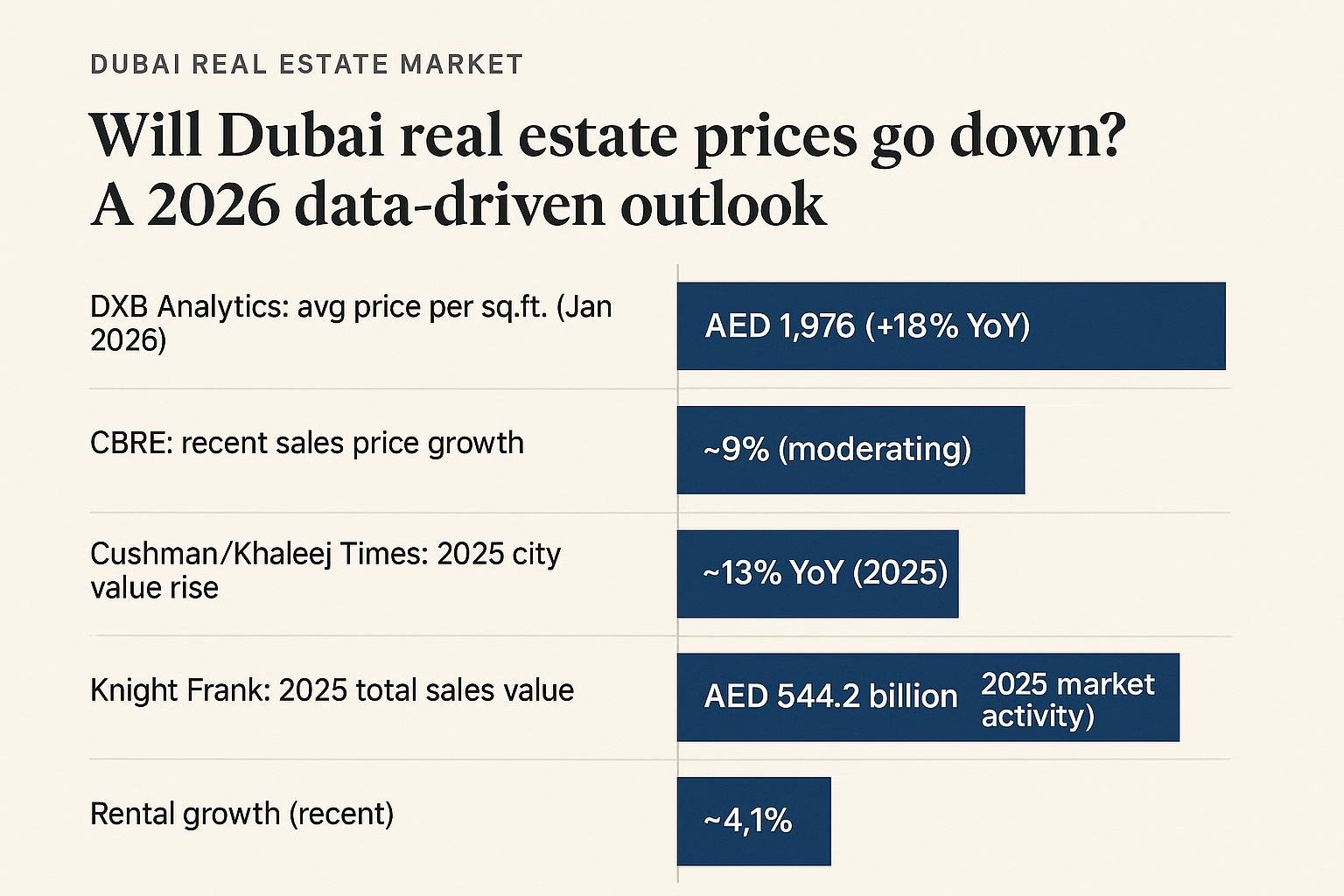
- DXB Analytics (DLD transaction data) shows the market‑wide average price per sq.ft. rising to about AED 1,976 in January 2026 (c. +18% year‑on‑year from Jan 2025). (dxbanalytics.com)
- Major broker research reports (CBRE, Knight Frank, Cushman & Wakefield and others) describe slowing but positive price growth at the city level in early 2026, with quarterly moderation compared with the exceptional gains of 2022–2024. CBRE reported sales price growth moderating to around 9% (recent review). (cbre.com)
- Analysts warn that risks are concentrated: oversupply and discounting pressure are most likely in specific affordable or peripheral off‑plan segments rather than across the entire market. (khaleejtimes.com)
Why prices may not broadly fall — structural supports
Several structural factors support prices in many parts of Dubai: elevated international demand (tourism and relocation), a high share of cash buyers, developer payment plans that reduce immediate mortgage dependency, and a limited supply of high‑quality family villas in core communities. These drivers underpin continued demand for prime and well‑located stock. (cbre.com)
Where downward pressure could appear
Downside risk is concentrated and conditional. Expect pressure or selective price easing in:
- Newly delivered off‑plan or peripheral apartment blocks with weak end‑user demand — developers may offer promotional discounts or payment incentives.
- Segments exposed to rising financing costs if local borrowing conditions shift or if buyer sentiment weakens materially.
- Areas with concentrated speculative stock where transaction volumes fall sharply. Recent local reporting highlights early evidence of discounting in a handful of prime resale listings and some developer offers in late 2025/early 2026. (realestateclubdubai.com)
Data comparison table — selected market metrics
| Metric | Reference period / value | Source |
|---|---|---|
| Average price per sq.ft. (Dubai) | ~AED 1,976 (Jan 2026); +18% YoY vs Jan 2025 | DXB Analytics / DLD. (dxbanalytics.com) |
| City‑wide sales price growth | Moderating to c. 9% (recent quarter review) | CBRE Q1 2026 market review. (cbre.com) |
| Residential value rise (2025) | c. 13% YoY (city‑wide assessment cited in local reporting) | Cushman & Wakefield / Khaleej Times summary. (khaleejtimes.com) |
| Total 2025 transaction value (market) | AED 544.2 billion (reported figures for 2025 market activity) | Knight Frank / market reports. (content.knightfrank.com) |
| Rental growth (recent) | Rental increases easing to ~4.1% YoY | CBRE Q1 2026. (cbre.com) |
Interpreting the signals — balanced view
Putting the pieces together: high transaction volumes and rising average price per sq.ft. show continued demand in aggregate, yet broker notes of moderation and a pipeline of new supply mean the market is moving to a more selective, two‑speed state. Prime, established communities and villas—where supply is tight—are likely to do better; peripheral or highly‑supplied apartment clusters may see discounts or slower price growth. (dxbanalytics.com)
Practical next steps for different market participants
- Buyers (owner‑occupiers): prioritise location, delivery track‑record of the developer, and rental yield if you may lease. Look for projects with completed or near‑complete delivery to reduce execution risk.
- Investors (short/medium term): focus on cashflow (rents), proven micro‑locations, and resale liquidity. Be cautious in off‑plan projects without strong presales.
- Sellers: price competitively against recent comparable transactions; consider buyer incentives that preserve headline price where possible (payment plans, covered service charges for a period).
- Long‑term holders: Dubai remains a growth market for many buyers due to population and tourism tailwinds — a hold strategy on well‑located assets is commonly recommended by local research houses. (cbre.com)
FAQ
Q: Will all Dubai property prices fall in 2026?
A: No. Broad, uniform falls are unlikely; instead expect moderation and selective weakness in oversupplied pockets while prime and family housing remain relatively resilient. (khaleejtimes.com)
Q: Should I wait to buy because prices will drop?
A: Timing depends on your horizon. If you’re buying to live, prioritise location and fit. If buying to trade short term, accept higher volatility and build in buffers for yield and potential small corrections. Conduct project‑level due diligence. (realestateclubdubai.com)
Q: What signals indicate prices are likely to fall in a neighbourhood?
A: Rising listings vs transactions, developer discounting, extended vacancy for new deliveries, and slowing transaction volumes are early warning signs. Monitor DLD transaction data and reputable broker reports. (dxbanalytics.com)
Note: This article summarises recent market data and expert commentary; it is informational only and not financial, legal or investment advice. Always consult a licensed advisor for decisions tailored to your situation.
Want help with this Dubai property question?
Share your goal, budget, and preferred area. Real Dubai Deals can help you understand the next practical step.