








How to Short Dubai Real Estate: Practical, Responsible Strategies (2026)
Shorting real estate directly is impossible in the same way you short a stock, but investors can take bearish or hedged positions that profit if Dubai property values or developer performance fall. Below I outline the realistic, regulated routes available in 2026, show current-market data to inform timing, and give practical next steps and risk controls. This is educational content and not investment advice.
Market snapshot — why data matters before taking a short
Dubai’s property market remained active into 2025–2026: official transaction and pricing datasets show elevated volumes and strong recent price moves that affect short strategies and costs. Use up-to-date DLD/market-provider figures before placing any trade. For context, a widely used market monitor reported average prices around AED 1,976/sqft in January 2026 (roughly +18% year-on-year vs Jan 2025). (dxbanalytics.com)
Official and industry reports recorded very large transaction volumes and values in 2025 (for example, roughly 245,178 transactions worth AED 833.47 billion recorded in 2025), with Q1–2026 continuing to show substantial activity. These activity levels affect liquidity and borrowing costs for short trades. (aigentsrealty.com)
Primary ways to short or hedge Dubai real estate exposure
Below are the main, practical instruments and approaches that investors and traders have used to take a bearish or hedged position on Dubai property-related risk.
1) Regulated short selling of Dubai-listed property equities
Many major Dubai developers (for example, Emaar, DAMAC and other listed names) are traded on the Dubai Financial Market (DFM). The DFM operates a Regulated Short Selling (RSS) framework and maintains a list of RSS-eligible securities; approved brokers can facilitate short sells subject to borrowing and settlement rules. Institutional and retail investors who meet broker requirements can potentially short eligible Dubai-listed stocks directly. (assets.dfm.ae)
- Who it suits: investors who want a targeted bet on a developer or property stock.
- Key constraints: you need an approved broker, locate/borrow of shares, margin, and pay borrowing fees; liquidity can vary by stock and time of market stress.
2) CFDs and margin products offered by international brokers
Contracts-for-difference (CFDs) let traders take short positions on price movements without owning the underlying shares. Global and regional brokers offering CFD access (including providers operating in the UAE and MENA region) make it possible to short equities and, in some cases, indices tied to UAE markets. CFDs are leveraged and carry overnight financing costs and counterparty risk, so use them only with full understanding of terms. (home.saxo)
- Who it suits: active traders seeking short-term exposure with lower operational friction than borrowing shares.
- Key constraints: higher leverage, financing/holding costs, and not all Dubai/ADX/DFM tickers may be available as CFDs.
3) Equity derivatives, single-stock futures and index futures
DFM and Nasdaq Dubai offer derivative products such as single-stock futures for approved securities. Derivatives provide an alternative route to take short exposure with known margining and clearing procedures. Availability and the exact set of instruments change over time so confirm current listings with the exchange or a licensed broker. (dfm.ae)
4) Shorting REITs and publicly listed property funds
If you prefer exposure to income-producing property rather than developers, consider shorting or buying puts on listed UAE REITs where available (for example, ENBD REIT and other listed property funds historically available on Nasdaq Dubai and related venues). Liquidity tends to be lower than large-cap equities, which impacts borrow cost and slippage. (enbdreit.com)
5) Indirect hedges and international instruments
If direct shorting in UAE markets is operationally difficult, investors can use indirect hedges: short regional property or bank stocks that are correlated to Dubai real estate, buy put options on global luxury or construction peers, or use macro instruments (e.g., short USD-pegged rate plays if interest-rate sensitivity is the concern). Correlation is imperfect—these are hedges, not precise shorts.
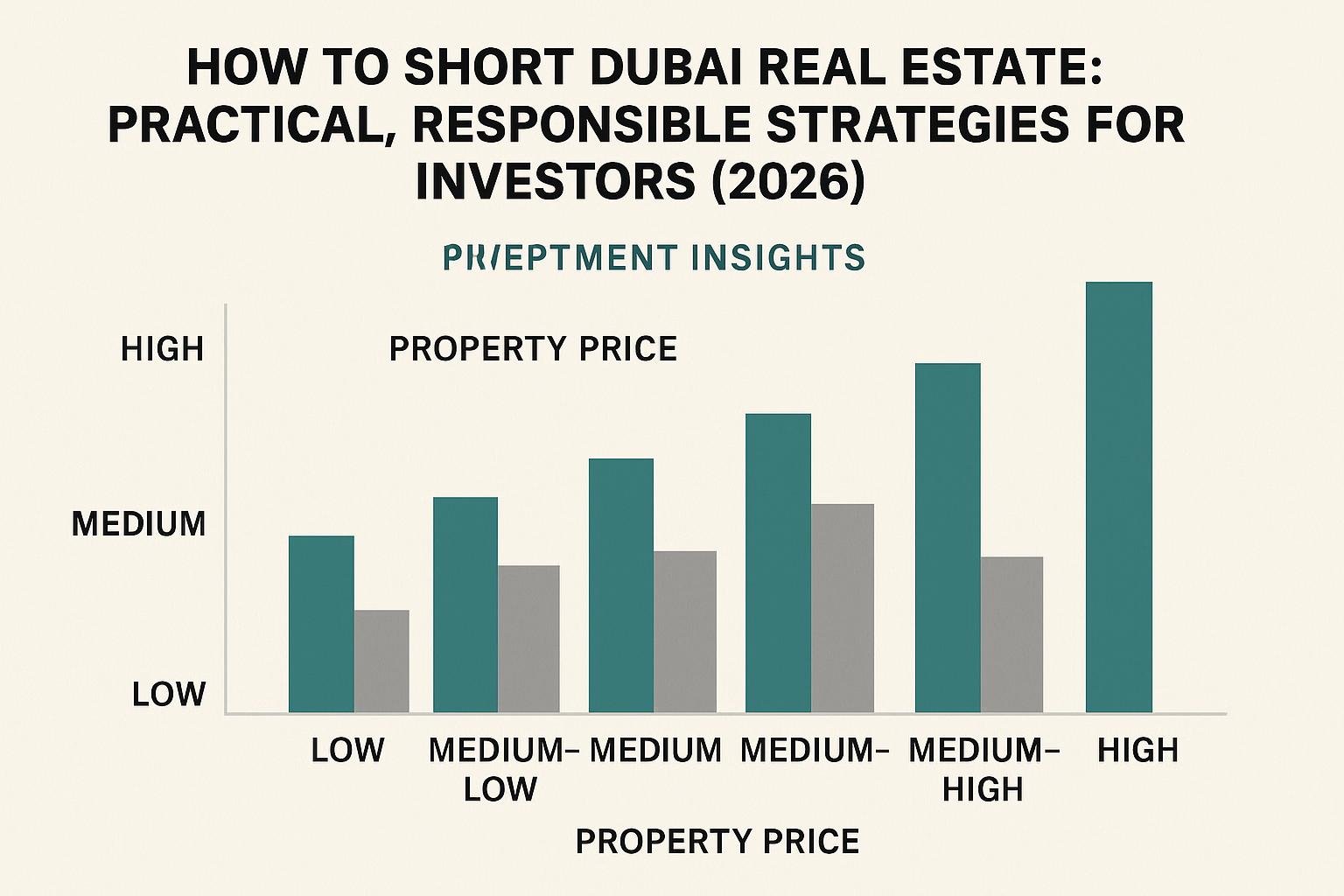
Market Data Comparison / Data Snapshot
Below is a compact table comparing high-level market metrics important for shorting decisions: price momentum, liquidity and transaction value. Use this snapshot as a starting point — always refresh figures with primary sources before trading.
| Metric | Recent value | Reference period | Source |
|---|---|---|---|
| Average price per sqft (Dubai) | AED 1,976 / sqft | Jan 2026 | DXB Analytics (DLD-based index). (dxbanalytics.com) |
| Transactions (annual) | ~245,178 transactions | 2025 full year | DLD-derived market compilation (industry report). (aigentsrealty.com) |
| Transaction value (annual) | AED 833.47 billion | 2025 full year | Industry report summarising DLD data. (aigentsrealty.com) |
| Institutional market view | Broad-based growth with elevated volumes; market monitoring recommends caution on momentum-based assumptions | Q4 2025–Q1 2026 commentary | CBRE and market analysts. (mediaassets.cbre.com) |
Practical next steps — a controlled checklist
- 1) Confirm your exposure: quantify how much of your portfolio is directly or indirectly tied to Dubai real estate (by % of NAV or notional value).
- 2) Choose instrument: decide between direct short (DFM RSS eligible stocks), CFDs, single-stock futures, or indirect hedges (REIT puts, correlated banks). Check availability and liquidity for your chosen ticker.
- 3) Open and qualify an account: use a DFM/Nasdaq Dubai licensed broker for on-exchange shorting, or a regulated CFD broker (Saxo, IG and others operate in the region) for CFD exposure. Confirm margin and borrowing rules. (home.saxo)
- 4) Check borrow and financing costs: ask your broker for stock-lend availability and daily/overnight financing rates for CFDs.
- 5) Size and risk-manage: set stop-loss/close rules, limit position size vs capital, and consider partial hedges (options or collars) where available.
- 6) Monitor market indicators: DLD transaction volumes, price-per-sqft trends, developer pre-sale volumes and macro cues (tourism, visa policy, interest rates).
Risks, caveats and regulatory points
Shorting has asymmetric risk (loss is potentially unlimited), margin calls, and borrowing/financing costs that can eliminate theoretical profits. Dubai’s exchanges use an RSS framework with locate/borrow rules; not every security is always eligible or easy to borrow. Market depth, holiday schedules, currency pegs (AED–USD) and government policy interventions can change outcomes quickly. Always check the latest exchange rules before attempting regulated short sales. (assets.dfm.ae)
FAQ
Can I short property directly in Dubai?
No. You cannot short a physical building. You short financial instruments linked to property: listed developer shares, REITs, CFDs or derivatives that track the performance of those firms or indices.
Is shorting available to retail investors in the UAE?
Retail access depends on the instrument and broker. The DFM’s Regulated Short Selling program and some CFD providers make shorting possible for qualified retail clients; you must satisfy margin and borrowing/eligibility requirements. (assets.dfm.ae)
What are cheaper ways to hedge if borrow costs are high?
Consider partial hedges: short correlated financials, buy put options (where available), or use inverse positions on correlated international sectors. These are imperfect but may cost less than prolonged stock borrow fees.
Any tax or legal considerations?
Tax residency, stamp duty and withholding tax rules depend on your domicile. The UAE has specific securities regulation and you should consult a licensed tax or legal advisor for personal tax or legal implications.
Summary and responsible approach
Short exposure to Dubai real estate is feasible through regulated short-selling of listed property stocks, CFDs, exchange-traded derivatives and REITs, or by constructing indirect hedges. Market liquidity, borrow availability and financing costs are the primary practical constraints; up-to-date market metrics (DLD transaction volumes, price-per-sqft trends and exchange RSS listings) should guide execution. Use small, well-documented position sizes, clearly defined exit rules and consult regulated brokers and professional advisors before executing complex or leveraged short strategies.
If you’d like, I can: (a) prepare a checklist tailored to your specific holdings, (b) check current RSS-eligible developer tickers and borrow costs with sample brokers, or (c) model a simple hedge sized to a hypothetical portfolio — tell me which and I’ll research live availability and fees.
Want help with this Dubai property question?
Share your goal, budget, and preferred area. Real Dubai Deals can help you understand the next practical step.