







How to Invest in Dubai Real Estate Stocks: A Practical 2026 Guide
Dubai’s property sector remains a major part of the UAE economy and is accessible to investors through listed stocks and REIT-style vehicles on the Dubai Financial Market (DFM), Nasdaq Dubai and the Abu Dhabi Securities Exchange (ADX). This article explains the practical routes to invest in Dubai real estate stocks, compares a short list of listed issuers, and offers step-by-step next actions and a FAQ to help you get started — with cautious, sourced facts so you can follow up independently.
Why consider Dubai real estate stocks?
Listed property companies and real estate-related names let investors gain exposure to project pipelines, recurring rental income and large-scale asset appreciation without owning physical property. Key attractions in 2026 include continued tourist and migration demand to Dubai, growing capital markets support for regional listings, and a deepening broker ecosystem that makes access easier for non-residents. However, stocks are subject to market and development-cycle risk — treat them differently from direct property ownership and diversify accordingly.
Sources note increased market activity and a growing number of retail and international participants on UAE exchanges in early 2026. (feeds.dfm.ae)
Where to find Dubai real estate stocks (exchanges and typical tickers)
Most Dubai-focused developers and real-estate-related securities trade on the Dubai Financial Market (DFM) or Nasdaq Dubai; some large regional peers are listed on ADX (Abu Dhabi). Typical names often used by investors include Emaar Properties (DFM: EMAAR / EMAR in some feeds), Emaar Development (EMAARDEV), Deyaar (DEYAAR) and Union Properties (UPP). In the broader UAE peer set, Aldar Properties (ADX: ALDAR) is a frequently-cited large-cap comparator. Always confirm ticker and exchange with your broker before trading. (investing.com)
How to buy: practical steps (international and UAE residents)
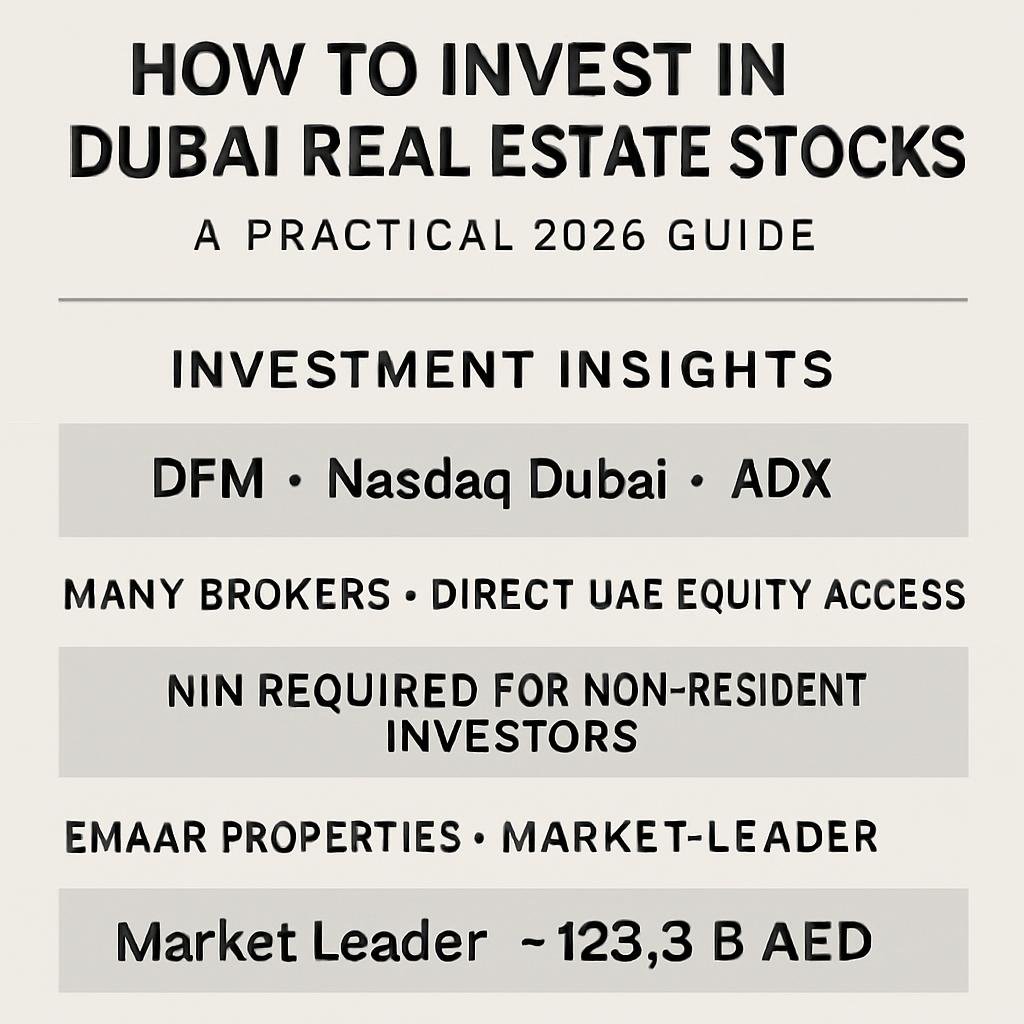
- Choose a broker with UAE market access. Many international brokers (and an increasing number of regional digital platforms) now provide direct access to DFM/Nasdaq Dubai/ADX. Examples include global firms that announced UAE connectivity in 2025–2026; local licensed broker lists are maintained on DFM’s website. Confirm fees, settlement currency (AED) and whether the platform will help you obtain a DFM Investor Number (NIN). (uaeadvisorguide.com)
- Get your DFM Investor Number (NIN) and complete KYC. Non-resident investors typically need an investor ID (NIN) and a broker relationship to trade directly on DFM/Nasdaq Dubai. Many brokers will handle the NIN application as part of onboarding; confirm required documents (passport, proof of address, tax ID, depending on jurisdiction). (bayut.com)
- Fund your account and consider currency. Trades settle in UAE dirhams (AED). Some brokers offer AED accounts; others will convert from your base currency — check conversion costs, settlement timing and margin rules. (interactivebrokers.co.uk)
- Decide your exposure method. Direct single-stock buying (developers, mall operators), UAE-focused ETFs (if available in your market) or listed REITs/Sukuk provide different risk/return profiles. ETFs may offer diversified exposure; single stocks allow concentrated bets on specific developers or platforms. (brokerlistings.com)
- Do fundamental and project due diligence. For developers, review recent earnings, landbank, delivery record and balance-sheet leverage; for mall or asset managers, review occupancy, rental reversion and long-term leases. Use company reports and exchange filings. (feeds.dfm.ae)
- Plan tax, residency and regulatory implications. UAE has no personal income tax on capital gains for most retail investors, but your home country tax rules may apply — seek tax advice. Also note local regulations around foreign ownership of certain property assets differ from stock ownership rules. (century.ae)
Market Data Comparison (Data Snapshot)
Below is a concise snapshot comparing a small selection of UAE-listed real-estate-related issuers. Figures are presented with source and date — treat them as illustrative starting points and confirm live quotes before trading.
| Company | Ticker / Exchange | Notable metric (source & date) | Business focus |
|---|---|---|---|
| Emaar Properties | EMAAR / DFM | Market cap reported ~123.3 B AED (2026 data snapshot). Latest traded price example: AED 12.48 on 6 May 2026 (historical feed). (eulerpool.com) | Large-scale developer (master-planned communities, towers, malls, hospitality). |
| Emaar Development (Emaar Dev) | EMAARDEV / DFM | Live feed and trading pages available on market sites; trading volume and price are exchange-listed (example snapshots on investing feeds). Confirm current price with broker. (es.investing.com) | Residential and mixed-use development arm (off-plan and completed residential projects). |
| Deyaar Development | DEYAAR / DFM | Company published FY/Q1 2025–Q1 2026 results and filings (see Deyaar investor releases for latest figures). (feeds.dfm.ae) | Residential and commercial developer with active project pipeline in Dubai. |
| Union Properties | UPP / DFM | Published audited 2025 financial results; see company releases for recent metrics before trading. (up.ae) | Mixed-use residential and commercial development projects in Dubai. |
| Aldar Properties (peer) | ALDAR / ADX | Market cap ~58.8 B AED (June 2026 snapshot). Use as a UAE large-cap property peer for valuation comparisons. (tradingeconomics.com) | Abu Dhabi–focused master developer with investment management business. |
How to pick between stocks, REITs, and ETFs (short checklist)
- Goal: income (look for dividend history / REITs) vs growth (developers with large landbanks).
- Liquidity: large caps (Emaar, Aldar) usually trade more actively; smaller developers can be illiquid and volatile.
- Balance sheet: prioritise lower net-debt-to-assets ratios if you want cyclical resilience.
- Portfolio fit: limit single-stock exposure to a modest percentage of your equity allocation; use ETFs/REITs to diversify real-estate exposure.
Practical next steps (a four-item action plan)
- Open an account with a broker that offers DFM/ADX/Nasdaq Dubai access or confirms they will obtain a NIN for you. Verify fees and AED settlement. (dfm.ae)
- Download recent annual and quarterly reports for any company you’re considering (check exchange filings and the company IR page). Focus on backlog, cash flow, and delivery record. (feeds.dfm.ae)
- Start small and monitor liquidity and price behaviour for a few weeks; consider limit orders to manage entry price and currency effects.
- Set objective exit rules and review tax implications in your resident jurisdiction; consider a conversation with an independent tax/advisor for cross-border holdings.
FAQ
Can non-residents invest directly in Dubai-listed real estate stocks?
Yes. Non-resident investors can generally invest through licensed brokers and by obtaining a DFM Investor Number (NIN) — many brokers will assist with the process. Confirm specific KYC requirements with your chosen broker. (bayut.com)
Are there UAE real-estate ETFs I can buy from abroad?
There are UAE-focused ETFs listed on international platforms that provide basket exposure to UAE equities (some include large property names). Availability depends on your broker and local regulations — ask your platform about UAE or MENA real-estate/market ETFs. (brokerlistings.com)
Do Dubai real estate stocks pay reliable dividends?
Dividend policies vary by company and by year; some large developers pay regular dividends when cash flow allows, while others reinvest for growth. Check the company’s dividend history in its investor relations materials before assuming yield stability. (feeds.dfm.ae)
What are the main risks?
Key risks include construction-delays and project delivery risk, leverage on developer balance sheets, commodity/cost inflation for construction, and broader macro cycles that affect end-demand. Liquidity risk on smaller-listed names is also important. Diversify and size positions accordingly.
Closing notes & caution
This article is a practical starting point, not investment or tax advice. Markets move and company metrics change — always confirm live prices, up-to-date filings and broker specifics before placing orders. For tax or legal matters, consult a licensed professional in your jurisdiction.
Useful starting sources are the DFM broker directory, recent exchange market commentary and primary company investor relations pages — links and references used to build this guide are listed below so you can verify figures and get live quotes. (dfm.ae)
Want help with this Dubai property question?
Share your goal, budget, and preferred area. Real Dubai Deals can help you understand the next practical step.