


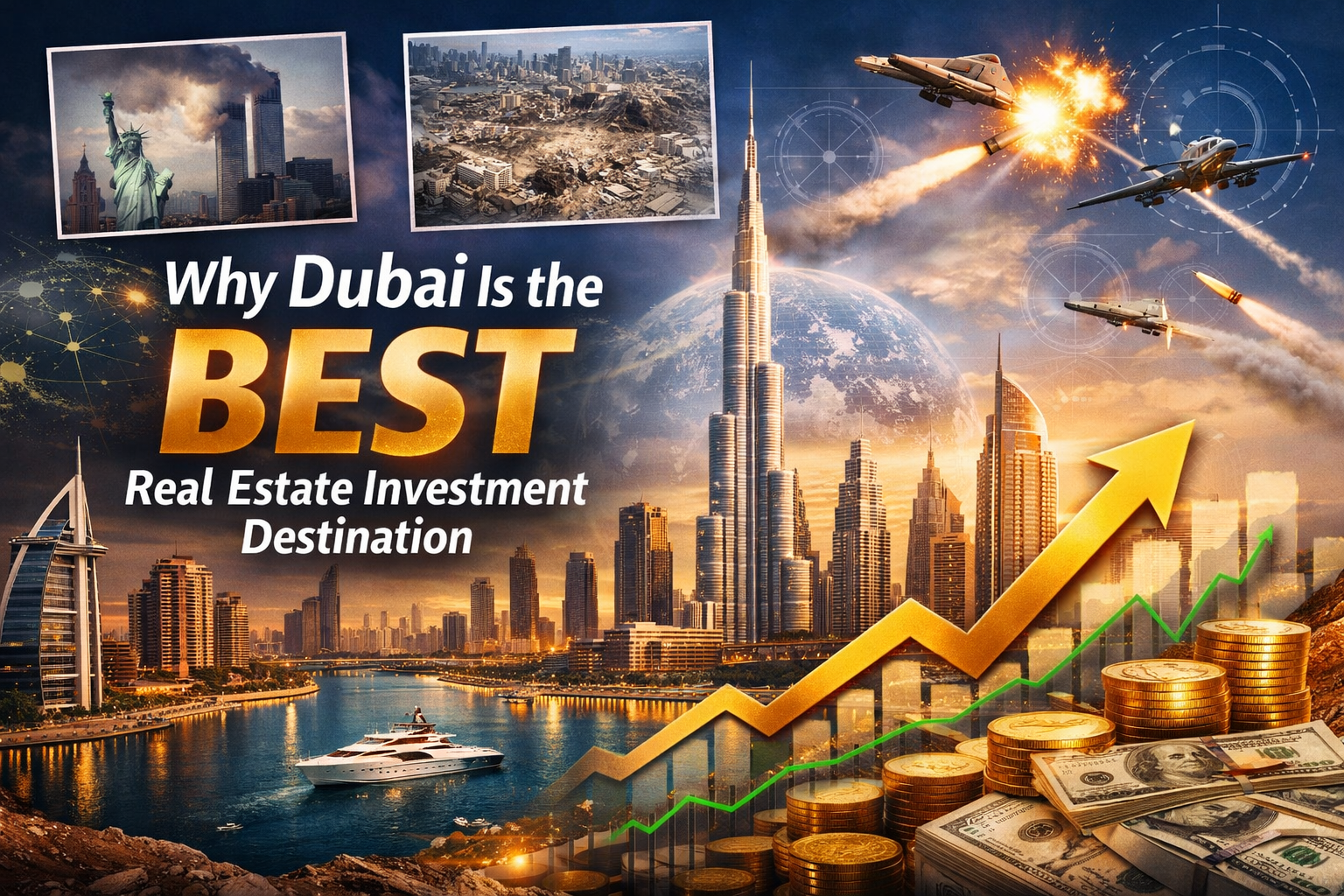
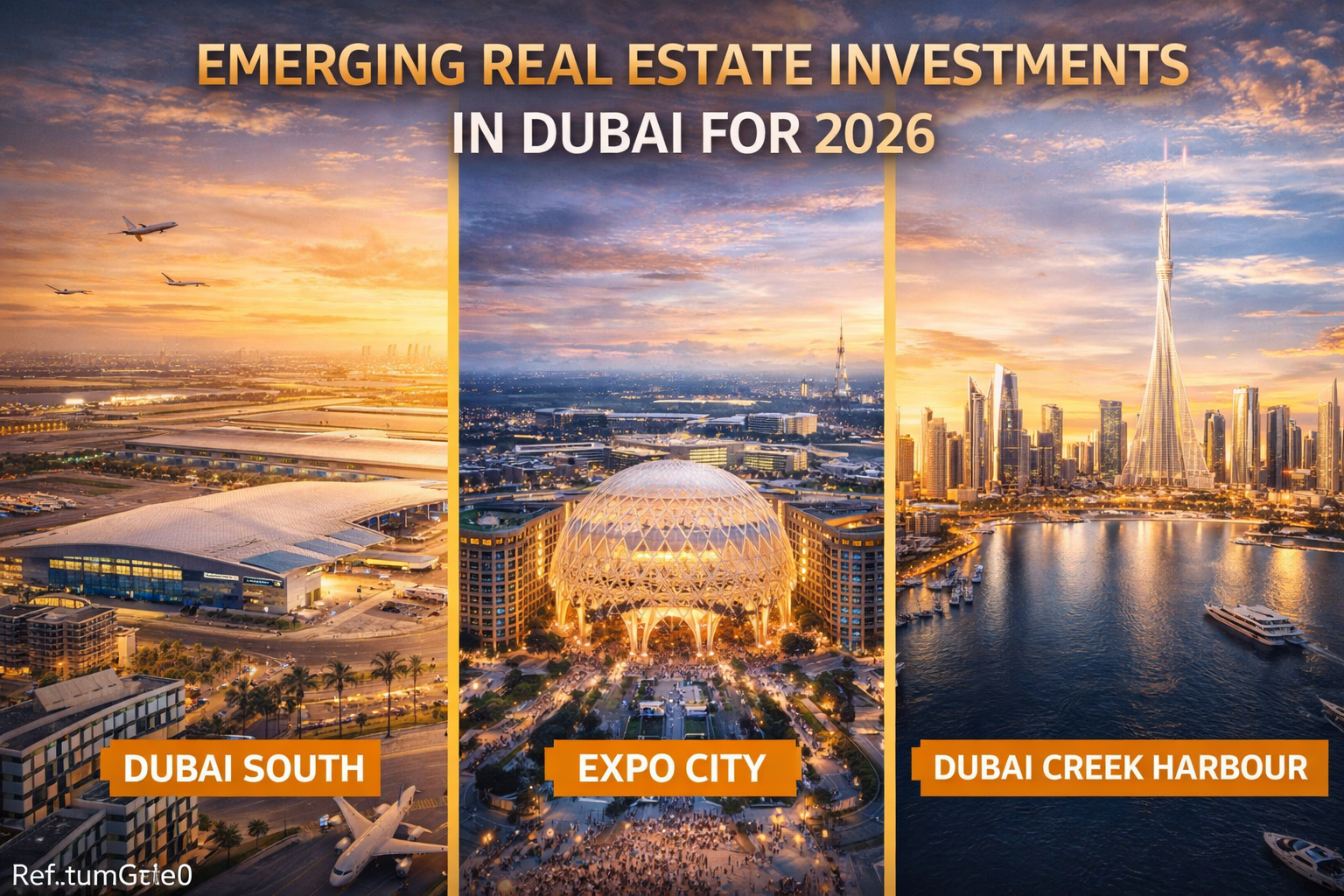


Real estate markets look strongest when money is easy, sentiment is positive, and the global backdrop is calm. That is not the moment serious investors should judge them. The real test comes after disruption: terrorism, war, airspace closures, financial tightening, supply-chain stress, and geopolitical fear. Those moments expose the difference between markets built on marketing and markets built on structure. Dubai’s case has become stronger precisely because it has now been tested repeatedly under pressure and has continued to function as a live investment city, not just a headline story. (IMF)
The argument for Dubai is not that it is risk-free. It is that it has shown an unusual ability to absorb shocks, preserve continuity, restore confidence quickly, and keep capital moving while many other markets would be dealing with longer paralysis. That is a far more important investment trait than perfection. For property investors, the key issue is never whether risk exists. Risk exists everywhere. The real question is whether institutions, infrastructure, policy, liquidity, and public confidence remain intact when risk actually arrives. Dubai has repeatedly shown that they do. (IMF)
Dubai’s investment case is built on fundamentals, not mood
Dubai’s strength starts with the wider UAE state structure. The UAE is a constitutional federation with a federal government and emirate-level governments operating inside a system designed for coordinated execution. For investors, that matters because speed of decision-making and clarity of authority become critical during crises. In fragmented systems, the problem is often not lack of resources but slower alignment. Dubai benefits from operating inside a political model that can move faster than many democratic but more procedurally layered markets. (U.AE)
The second layer is macro resilience. The IMF said in its 2025 Article IV consultation that the UAE had shown significant resilience to global volatility and regional tensions, with non-oil sectors including tourism and real estate continuing to expand, and with the financial system continuing to attract foreign capital while absorbing market volatility well. That matters because property markets do not operate independently of the banking system, business climate, and overall credibility of the economy. A city can have attractive towers and still be a weak investment environment if the macro base is unstable. Dubai benefits from a much stronger macro base than many critics admit. (IMF)
The third layer is sovereign strength and capital depth. Mubadala alone reported AED 1.2 trillion in assets under management for 2024. That does not mean Dubai real estate is state guaranteed, and it should not be framed that way. But it does mean the wider UAE sits inside a very deep pool of sovereign and state-linked capital, which materially strengthens external confidence in the country’s ability to absorb shocks, fund priorities, and maintain systemic stability. Investors may be buying a private apartment or villa, but they are doing so inside a country with serious financial backing. (Mubadala)
The fourth layer is tax efficiency. The UAE still does not levy personal income tax, and the Federal Tax Authority states that real estate investment income and personal investment income of natural persons are not treated as business income for UAE corporate tax purposes. That is a major advantage because many property markets appear attractive until tax drag is properly calculated. Acquisition taxes, annual taxes, rental-income taxes, and capital gains exposure can significantly change the real return. Dubai continues to stand out because the holding environment remains unusually efficient by global standards. (FTA UAE)
Why resilience matters more than image
A luxury market can survive on image for only so long. A serious investment market survives because people believe the system will continue functioning tomorrow. That belief comes from evidence. In 2025, Dubai International Airport handled 95.2 million passengers, the busiest year in its history and the highest annual international passenger traffic recorded by any airport. That is not a side note. It is proof of the scale of the city’s operating ecosystem. A market with that level of aviation throughput, business traffic, and global integration does not behave like a fringe property play. It behaves like a major hub. (Dubai Airports)
That operating scale is exactly why recent security stress matters. Investors should not only ask whether a country came under threat. They should ask what happened next. Did airports shut for long? Did daily life freeze? Did capital flee? Did confidence collapse? Or did the system continue to operate with temporary disruption but without systemic breakdown? Dubai’s recent performance is important because it points to continuity under pressure rather than collapse under pressure. (WAM)
Missile and drone interception is not just a defence story. It is an investment story.
Most people see missile interception as a military statistic. Investors should see it as a continuity statistic.
According to Reuters’ March 10, 2026 factbox based on Gulf defence ministry data, the UAE had, by March 9, detected 253 ballistic missiles and intercepted 233 of them, while 18 fell into the sea and only 2 landed on UAE territory. Reuters also reported that the UAE had detected 1,440 drones and intercepted 1,359 of them, and that all 8 detected cruise missiles had been destroyed. That implies extremely high operational effectiveness under live conditions: roughly 92% for ballistic missiles, roughly 94% for drones, and 100% for the reported cruise missiles in that dataset. (Reuters)
The official count later rose further. WAM reported on March 28, 2026 that, since the start of the attacks, UAE air defences had intercepted 372 ballistic missiles, 15 cruise missiles, and 1,826 UAVs. A later WAM update the same day said the running total had reached 378 ballistic missiles, 15 cruise missiles, and 1,835 UAVs after fresh launches on March 27. Those are not symbolic figures. They show sustained defensive capacity over time, not a one-off successful day. (WAM)
Why does that matter to property investors? Because the value of real estate is driven by more than construction quality and location. It is driven by the market’s ability to keep airports functioning, protect business districts, maintain payments and logistics, reassure residents, and preserve the belief that the city remains open for business. High interception rates do not eliminate danger. They do help prevent that danger from becoming lasting economic paralysis. That is the difference between a bad headline and a damaged market. (WAM)
The UAE’s defence capability is stronger than many investors assume
The UAE’s performance is not happening in a vacuum. It reflects a layered air- and missile-defence architecture. The United States approved in March 2026 the sale of a long-range discrimination radar integrated with THAAD for the UAE, strengthening higher-end detection, tracking, and battle management capability. Public reporting and official material also point to the UAE’s established use of THAAD and Patriot-based layers. In simple terms, this matters because interception success depends not only on having interceptors but on having the radar picture, command integration, and system coordination to classify and engage threats quickly. (State Department)
That gives the UAE a different resilience profile from countries that may have wealth or infrastructure but not the same depth of integrated defensive architecture. Investors do not need to become military analysts to understand the implication. A city that sits inside a state with proven detection and interception capability has a stronger chance of preserving commercial normality under stress than one that must simply absorb the shock and rebuild confidence later. (State Department)
How the UAE compares with other countries under threat
Israel remains the region’s most famous and most battle-tested missile-defence state. Its layered architecture includes Iron Dome, David’s Sling, and Arrow systems, and during Iran’s April 2024 direct attack Reuters reported that more than 200 drones and missiles were launched, with allied forces helping Israel bring down nearly all of them. That was an extraordinary defensive performance. But it was also supported by a wider allied coalition. More importantly, the current prolonged conflict has shown that even highly advanced systems can experience leakage under sustained pressure. So Israel remains the benchmark for combat-tested sophistication, but it also shows that even elite defence networks face endurance stress in long campaigns. (Reuters)
Saudi Arabia also fields serious missile-defence capability and has long been associated with Patriot systems, while U.S. defence sale material has documented a major THAAD package for the kingdom. Saudi Arabia’s challenge is different: it is a much larger geography with a broader energy and infrastructure footprint and a longer history of incoming threats. Reuters reported in March 2026 that Saudi Arabia had been targeted by hundreds of missiles and drones and that authorities said the vast majority were intercepted. The issue for comparison is not necessarily weaker capability. It is lower public numerical transparency, which makes precise efficiency comparisons more difficult than in the UAE case. (Reuters)
Qatar has credible systems too. U.S. defence documents show Patriot and NASAMS-related capability, and Reuters’ March 2026 data showed Qatar intercepting 118 of 127 ballistic missiles, 47 of 63 drones, and 7 cruise missiles in the period it tracked. Those are meaningful numbers, but they still compare less favorably than the UAE’s reported performance on both scale and interception ratio. For investors, that matters because resilience is not just about owning modern systems on paper. It is about what those systems have demonstrated under repeated live pressure. (Reuters)
Bahrain and Kuwait play important defensive roles inside the Gulf security environment, but they do not carry the same global investor weight as Dubai. Reuters reported Bahrain citing Patriot involvement in a March 2026 interception incident. That shows capability, but not the same combination of global aviation centrality, capital-market importance, and transaction depth that makes Dubai’s resilience commercially more relevant to international real estate investors. (Reuters)
Japan is a useful comparison because it is one of the most sophisticated defensive states in Asia. Japan’s Ministry of Defense describes a multi-layered ballistic missile-defence system built around Aegis-equipped destroyers for upper-tier interception and Patriot PAC-3 for lower-tier interception, coordinated through an integrated command structure. Japan is highly credible institutionally and defensively. But its investment profile is very different from Dubai’s. It is a higher-tax, more mature, slower-growth property environment, and it is also exposed to major natural-disaster risk on top of external defence risk. So Japan demonstrates that strong defence capability alone does not automatically create a superior real estate market. (Ministry of Defense Japan)
Singapore is another strong benchmark. It is institutionally clean, financially credible, and has advanced air-defence capability. But from a real estate investor’s point of view, Singapore is intentionally less open. Its tax regime for foreign residential property buyers is much more punitive: the IRAS example still reflects a 60% Additional Buyer’s Stamp Duty for a foreigner purchasing a residential unit, on top of normal Buyer’s Stamp Duty rates. In other words, Singapore offers safety and credibility, but with much more entry friction for foreign capital. Dubai offers a more open and far less punitive capital-entry environment. (Default)
What Dubai handled differently
The best argument for Dubai is not that it faced no threat. It is that it handled threat without losing its commercial identity.
That is a crucial distinction. Many countries facing direct targeting experience the same sequence: transport restrictions deepen, business rhythm weakens, insurance concerns rise, consumer psychology deteriorates, and capital hesitates. Even when the state remains stable, the city’s investment case can suffer because normality feels less reliable. Dubai’s recent experience has shown something else. Threats were real, interceptions were repeated, and there was disruption, but the broader system continued operating. Airports continued to matter, the city remained globally connected, and the investment narrative was not replaced by a breakdown narrative. (Dubai Airports)
That is why missile and drone defence belongs in a real estate article at all. Not because investors need military detail for its own sake, but because infrastructure continuity under threat is one of the clearest tests of whether a city deserves a resilience premium. Dubai increasingly does. (WAM)
What history teaches from other shock-hit markets
Manhattan after 9/11 is a reminder that even the world’s most important gateway cities can suffer deep short- and medium-term dislocation after a major attack. Great cities recover, but recovery is not instant and often requires massive public intervention, rebuilding, and time. The lesson for investors is simple: institutional strength matters, but the path back can still be long and expensive. Dubai’s advantage in comparison is that recent shocks have looked more like operational interruptions than urban or economic dislocation on that scale. (IMF)
Japan after major earthquakes offers another lesson. Japan is arguably one of the world’s most disciplined resilience states, but resilience there is expensive because the hazard base is structural and recurring. That is an important contrast with Dubai. Dubai benefits from lower structural natural-disaster exposure while still operating inside a state with significant execution capacity, capital depth, and infrastructure quality. For investors, that means a different kind of risk-adjusted proposition. (Ministry of Defense Japan)
Singapore shows the other side of the equation. It has many of the characteristics investors want: strong institutions, reserves, credibility, and infrastructure. But it is not designed to be friction-light for foreign property capital. Its tax and stamp-duty regime is intentionally restrictive. So while Singapore is absolutely a serious comparison market, it is not a direct substitute for Dubai if the investor’s objective is growth plus tax efficiency plus openness. (Default)
Why Dubai remains hard to beat
Most global cities give investors one or two of the qualities they want. Dubai gives several at once.
It offers global connectivity. It offers tax efficiency. It offers strong brand recognition. It offers liquidity. It offers active international demand. It offers relatively low entry friction compared with many developed Asian and Western cities. And now, increasingly, it offers a track record of preserving operational continuity under actual regional stress. That combination is rare. (Dubai Airports)
Some cities offer safety but weak upside. Some offer growth but weak legal or operational clarity. Some offer institutional prestige but heavy taxes. Some offer mature depth but lower net returns. Dubai sits in a narrow category of markets that still combine growth, usability, capital efficiency, and resilience in the same place. That is why global capital keeps coming back to it. (IMF)
If not Dubai, then where?
This is the question serious investors should answer honestly.
If the priority is maximum conservatism and ultra-clean institutional reputation, Singapore is the obvious alternative. But it comes with much higher acquisition friction for foreign residential buyers. (Default)
If the priority is deeper sovereign comfort inside the same broader national framework, Abu Dhabi is a strong alternative. It sits inside the same federal system and benefits from extraordinary sovereign capital depth. But its property proposition is generally more defensive and less globally liquid than Dubai’s. (U.AE)
If the priority is ultra-mature institutional depth, then New York, London, Tokyo, and similar legacy gateway cities still matter. But they typically bring higher tax burdens, more regulatory complexity, and less net efficiency for many international real estate investors. Japan, for example, may be highly resilient defensively, but it is not a low-friction growth allocation story in the same way Dubai is. (Ministry of Defense Japan)
And that is the core answer. If an investor does not choose Dubai, they can certainly find strong alternatives. But in most of those alternatives they gain one strength and lose two. They may gain institutional conservatism but lose tax efficiency. They may gain defensive maturity but lose growth. They may gain prestige but lose openness. Dubai remains unusually strong because the overall balance is still hard to match. (IMF)
Final conclusion
The best real estate markets are not the ones that only rise when conditions are easy. They are the ones that continue attracting capital when the world becomes uncertain.
Dubai has done that.
It has done it while remaining one of the world’s busiest and most connected international hubs. It has done it while operating inside a tax-efficient and investor-friendly environment. It has done it with macro resilience recognized by the IMF. It has done it with serious sovereign financial backing in the wider UAE system. And, crucially, it has done it while facing live regional security stress and still preserving continuity through very high interception success and rapid normalization. (Dubai Airports)
That does not make Dubai perfect. It does not remove risk. It does mean that, judged against the standards that matter most to real investors, Dubai remains one of the strongest real estate allocation cases in the world today.
And if not Dubai, then the burden is on the alternative market to prove it offers a better combination of resilience, liquidity, openness, tax efficiency, and continuity.
Right now, very few do.

2 Comments
dubai real estate investment opportunities
March 26, 2024Really enjoyed reading this post. It explained the key benefits of dubai real estate investment opportunities in a simple and easy-to-understand way.
dubai real estate investment opportunities
March 26, 2024Really enjoyed reading this post. It explained the key benefits of dubai real estate investment opportunities in a simple and easy-to-understand way.