




The Hook: A Midnight Reset
At midnight on February 28, 2026, the UAE’s horizon was redefined by the precision of air defense tracers rather than the usual glow of the city’s skyline. In a high-stakes neutralization of regional hostilities, UAE systems intercepted a staggering 165 ballistic missiles, 2 cruise missiles, and 541 drones. While the technical success was near-absolute, the human cost provided a sober reality: three casualties—Pakistani, Nepali, and Bangladeshi nationals—and 58 minor injuries. Debris was reported across high-profile locales, including Etihad Towers and the facade of the Burj Al Arab. Yet, as dawn broke over the Gulf, the headlines of a “region on the brink” stood in stark contrast to the sentiment on the ground. In the marble-clad lobbies of DIFC and the sales centers of the Marina, the reaction was one of caution rather than panic. The question for the global elite is no longer if Dubai can survive such a shock, but why its capital markets now treat regional conflict as a “hiccup” rather than a catastrophe.
The “72-Hour Pause” and the Strategic Window
There is a quiet, rhythmic choreography to how Dubai’s capital markets absorb shock. Market strategists have identified a distinct behavioral pattern: the “72-hour pause.” This is not a market failure, but a tactical recalibration—a brief dip in transaction velocity where the volume of global headlines temporarily outweighs the speed of the pen. During this window, newer market entrants, often spooked by geopolitical “noise,” retreat to the sidelines to monitor news feeds.
However, for seasoned, liquid investors, this hesitation represents a strategic window. They recognize that while the sky may have momentarily flashed, the underlying economic engine remains unfazed. These veterans use this 48-to-72-hour window to acquire premium assets without the friction of hyper-competition that usually defines the Dubai market.
“Geopolitical noise always injects a natural 48-to-72-hour pause in transaction velocity as people absorb the headlines. However, this ‘wait-and-see’ sentiment primarily affects newer market entrants.” — Ritu Kant Ojha, CEO of Proact Luxury Real Estate.
Structural Defense: Why 2026 is Not 2008
To understand the 2026 resilience, one must analyze the architectural maturation of the market since the 2008 crash. The 2008 crisis was a house of cards built on heavy developer leverage and “purely speculative” flipping, where prices cratered by 40–50% because the demand was largely imaginary.
The 2026 market, by comparison, is armored with data and real humans. Dubai recorded 45,485 property transactions worth Dh142.7 billion in Q1 2025 alone, a momentum that created a massive liquidity buffer before the tensions began. This growth is supported by actual population expansion—90,000 new residents arrived in Q1 2025 alone—and the longevity of the Golden Visa, which has transformed Dubai from a transient stopover into a permanent home for global wealth. Today’s market is end-user driven and protected by rigorous escrow reforms, making it “ready for any situation.”
The Primary Market Paradox: Blueprints Over Bricks
A fascinating “Primary Market Paradox” has emerged in the current cycle: investors are increasingly choosing blueprints over bricks, often paying higher premiums for off-plan units than for existing secondary stock. This is a flight to quality. Investors are no longer satisfied with “normal” standards; they are chasing the “super high standards” and “easy payment plans” of the newest clusters.
This preference is nowhere more evident than in the rivalry between the “two Palms.” While Palm Jumeirah remains iconic, it is a legacy project where transactions are often restricted to cash or heavy bank financing. In contrast, Palm Jebel Ali has become a “hot topic” for the sophisticated set; mansions there start at Dh25 million but come with flexible payment structures that high-net-worth individuals find more efficient for capital management. Similarly, the shift toward Creek Harbour—now recognized as the “new Downtown”—is fueled by the “Blue Line” metro expansion, which connects the cluster to the city’s core. Investors are buying into a future of integrated infrastructure rather than the aging inventory of the past.
Economic Armor: Resiliency from the Top Down
The UAE’s economic defense is as strategic as its military one. Abdulla Bin Touq Al Marri, the UAE Minister of Economy and Tourism, has maintained an authoritative calm, emphasizing that the nation’s logistics and supply chains are built to withstand such shocks. Port Jebel Ali continues to move goods without interruption, and food security remains uncompromised.
Crucially, the state has focused on “consumer behavior” as a primary stabilizer. By ensuring that retailers are stocked and price-stable, the government has prevented the panic-buying that often erodes market confidence. The result is an economy that continues to grow despite geopolitical “hiccups.”
“UAE, like said, have built a character for itself that really shows boldness and resilience through its systems.” — Abdulla Bin Touq Al Marri, UAE Minister of Economy and Tourism.
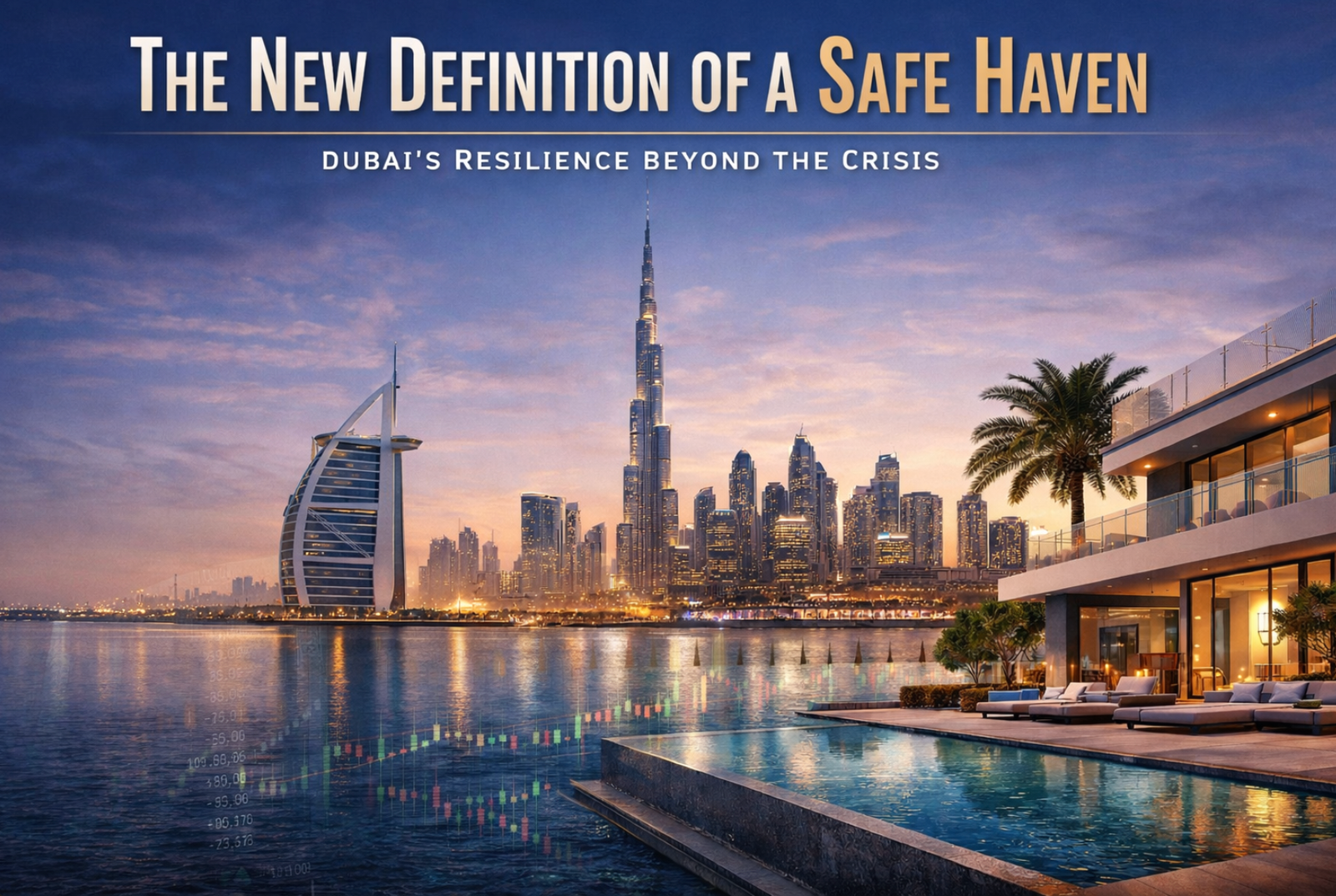
Summary: The New Definition of a Safe Haven
While regional tensions may cause a short-term “cooling” or moderation of demand, the fundamental investment thesis for Dubai remains intact. With rental yields persisting at 6–9%, a tax-free environment, and a strategic location, the city has successfully decoupled geopolitical proximity from economic risk. In previous decades, investors sought Dubai for rapid capital growth; in 2026, they seek it for structural durability.
Dubai has proven it can operate under pressure, turning military precision into market confidence. It leads one to a final, ponderous thought for the modern investor: In an era of global volatility, is “market resilience” now more valuable than “market growth”?