





Why Ciel Dubai Marina is getting investor attention
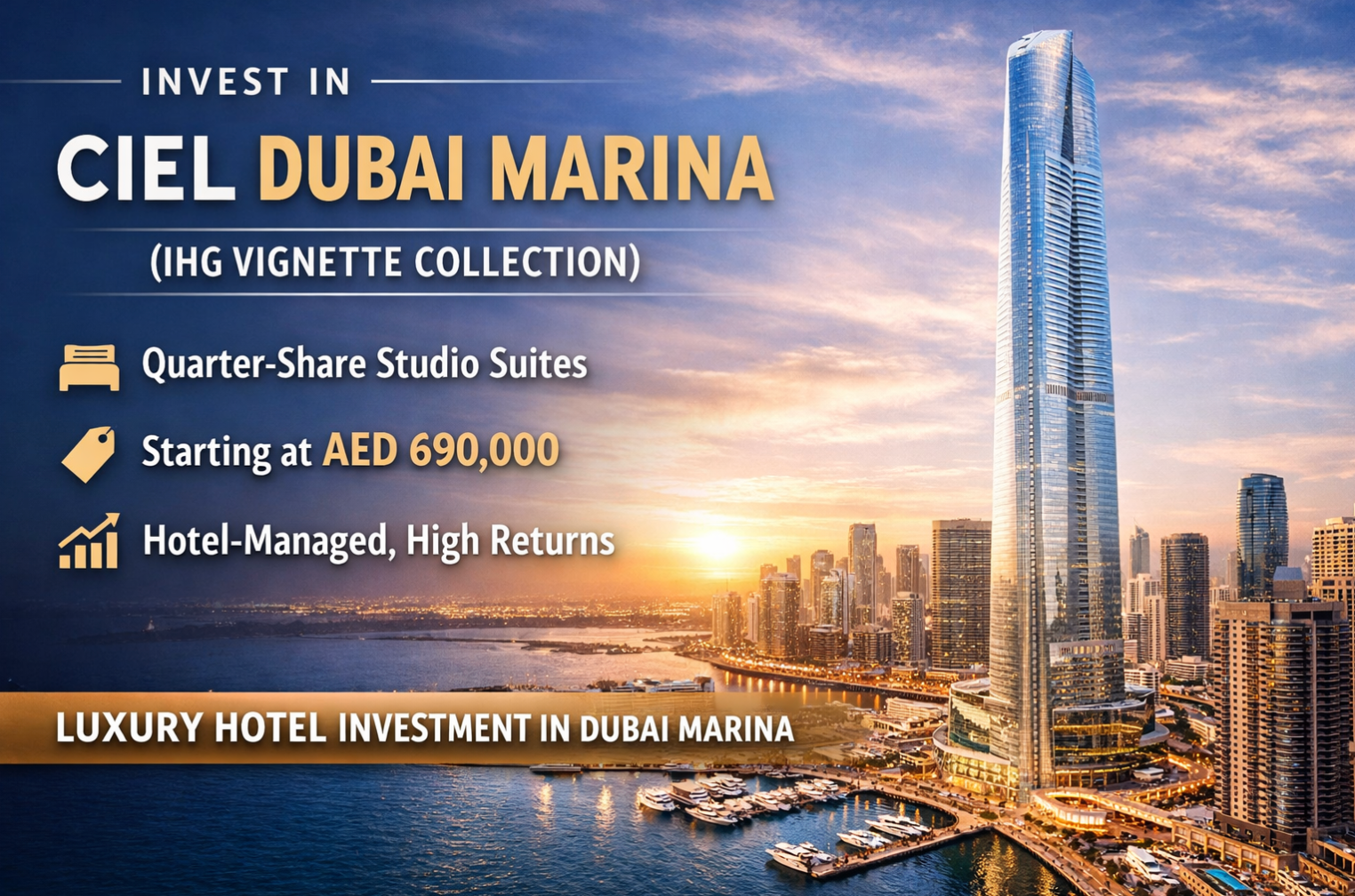
Ciel Dubai Marina is positioned as a landmark hospitality asset in one of Dubai’s most liquid tourism and rental zones. The project is marketed as the world’s tallest hotel at 377m with 82 floors and 1,004 rooms/suites, and it is managed by The First Group Hospitality under IHG’s Vignette Collection.
For investors, the appeal is straightforward: Dubai Marina is a high-demand visitor and short-stay zone, the IHG ecosystem strengthens distribution and booking reach, and hospitality performance can be tracked using clear KPIs like occupancy and ADR.
What is quarter-share ownership and why it feels easier than a normal buy-to-let
Quarter-share ownership means you own 25% of a unit rather than buying the full apartment. It reduces the entry ticket while giving exposure to hotel income performance, without the typical landlord responsibilities of tenant sourcing, renewals, and day-to-day operational decisions.
In this specific example listing on Property Finder, the offer is described as a quarter share of a studio in Ciel Tower/Dubai Marina with a listing price of AED 690,000.
This model is often considered “easy” because operations are handled by a professional hospitality operator, and the asset performance is driven by hotel demand and pricing rather than one fixed lease. At the same time, it should be treated like a business investment because your net payout depends on the operator agreement, including fees, reserves, and the distribution policy.
How returns are made in hotel investments: the two levers
Occupancy is the percentage of nights the hotel sells out of the available inventory. ADR (Average Daily Rate) is the average room rate achieved per sold night.
ADR matters because it reflects pricing power. Higher ADR can lift revenue even if occupancy stays the same, which supports stronger owner distributions and can improve resale valuation over time. For Ciel, published pricing examples have shown significant nightly rate ranges by season and room type, including rates such as Dh1,436 for a King Deluxe and around Dh2,006 for a King Suite during early December, with lower pricing shown in quieter mid-January examples.
A real listing example: the numbers investors care about
From the Property Finder listing, the current listing price is AED 690,000 and it is described as a quarter share (25%) studio in Ciel Tower, Dubai Marina.
Discount angle for this specific case
Using the reference original price you shared of AED 865,260, the gap versus the listing price is AED 175,260, which is a 20.26% discount. This matters because it lowers entry cost and can improve the overall return profile if hotel cash distributions perform well or if the market later reprices the share higher after stabilization.
Acquisition costs: what you should budget upfront
Based on the listing price and the cost items you specified, the estimated acquisition budget looks like this:
| Item | Calculation | Amount (AED) |
|---|---|---|
| Listing price | — | 690,000 |
| DLD fee | 4% of 690,000 | 27,600 |
| Agent fee | 2% of 690,000 | 13,800 |
| VAT on agent fee | 5% of 13,800 | 690 |
| Total acquisition costs | — | 42,090 |
| Estimated all-in (Price + Costs) | — | 732,090 |
Note: A trustee office fee is typically payable at transfer depending on the trustee office and transaction type. A developer/management NOC fee may also apply depending on the project and transfer process.
Investor scenarios: how to think about return ranges without guessing
Hotel-managed investments should be presented as scenarios because results depend on trading performance and the operator’s distribution policy. A simple way to underwrite is to monitor occupancy and ADR (the revenue drivers) and then apply the contract’s distributable percentage to estimate what could be paid out to owners after fees and reserves.
The key message is that returns are not fixed. They can strengthen in peak seasons when ADR and occupancy are high, and they can soften when the market discounts rates or demand drops. This is normal in hospitality and is also why branded hotels in prime locations can be attractive when they sustain pricing power.
Exit strategy: how investors typically get out
The clean exit is a secondary-market resale of your 25% share. The best timing is usually after the hotel has produced several quarters of operating results and payout statements, because the next buyer can underwrite the investment using real performance rather than projections.
A stronger exit price is typically supported by stable occupancy, resilient ADR, consistent owner distributions, strong brand visibility and guest feedback, and a smooth transfer process under the ownership agreement. Liquidity can be slower than standard apartments because it’s a fractional share, so performance documentation and transfer clarity become even more important.
Pros and cons: a clear investor-style view
Pros
Lower entry ticket via 25% ownership compared to buying a full unit
Hands-off model with professional hotel management
Return potential linked to hotel performance instead of one fixed lease
In this specific listing, a meaningful entry discount versus the reference original price
Cons
Income is not guaranteed and depends on hotel trading performance
Operator fees and reserves reduce distributable income
Resale liquidity may be slower than standard residential units
Seasonality can affect ADR and occupancy even in strong tourism markets
Who this investment is best for
This is best for buyers who want hands-off hospitality exposure, prefer professional management, and are comfortable with performance-based distributions. It’s less suitable for buyers who require guaranteed fixed monthly income, want instant liquidity, or want full personal control like a standard apartment.
Due diligence checklist before you invest
Confirm the share structure and ownership documentation
Review the operator distribution policy and full fee/reserve stack
Understand owner-usage rules and whether they reduce payout
Confirm the transfer process including trustee office steps and whether an NOC is required
Ask what performance and payout reporting you receive and how often
Final takeaway
Ciel Dubai Marina is positioned within a recognizable global hospitality ecosystem via IHG’s Vignette Collection and is marketed as a flagship, high-visibility hotel asset in Dubai Marina. Quarter-share ownership can be a practical way to access a hotel-managed investment at a lower ticket, and in this specific case the discounted entry price strengthens the upside narrative. The smart approach is to focus on occupancy and ADR, validate the operator payout structure, and plan the exit around a period when performance history is available and easy for the next buyer to underwrite.