






Is Now a Good Time to Invest in Dubai Real Estate? A 2026 Data‑Led Guide
Short answer: it depends on your goals, timeframe and location. Dubai’s market entered 2026 with strong momentum, record activity in 2025 and clear micro‑market differences. This article summarises the most relevant facts, shows a concise market data snapshot, highlights risks and practical next steps for prospective buyers and investors.
Market overview: headline facts
Dubai posted unusually high transaction activity in 2025 and continued momentum into early 2026. Measured by Dubai Land Department (DLD)‑based dashboards, total registered transactions and average prices per square foot rose sharply through 2024–2025 and into January 2026, driven by both domestic buyers and international HNWI demand. (dxbanalytics.com)
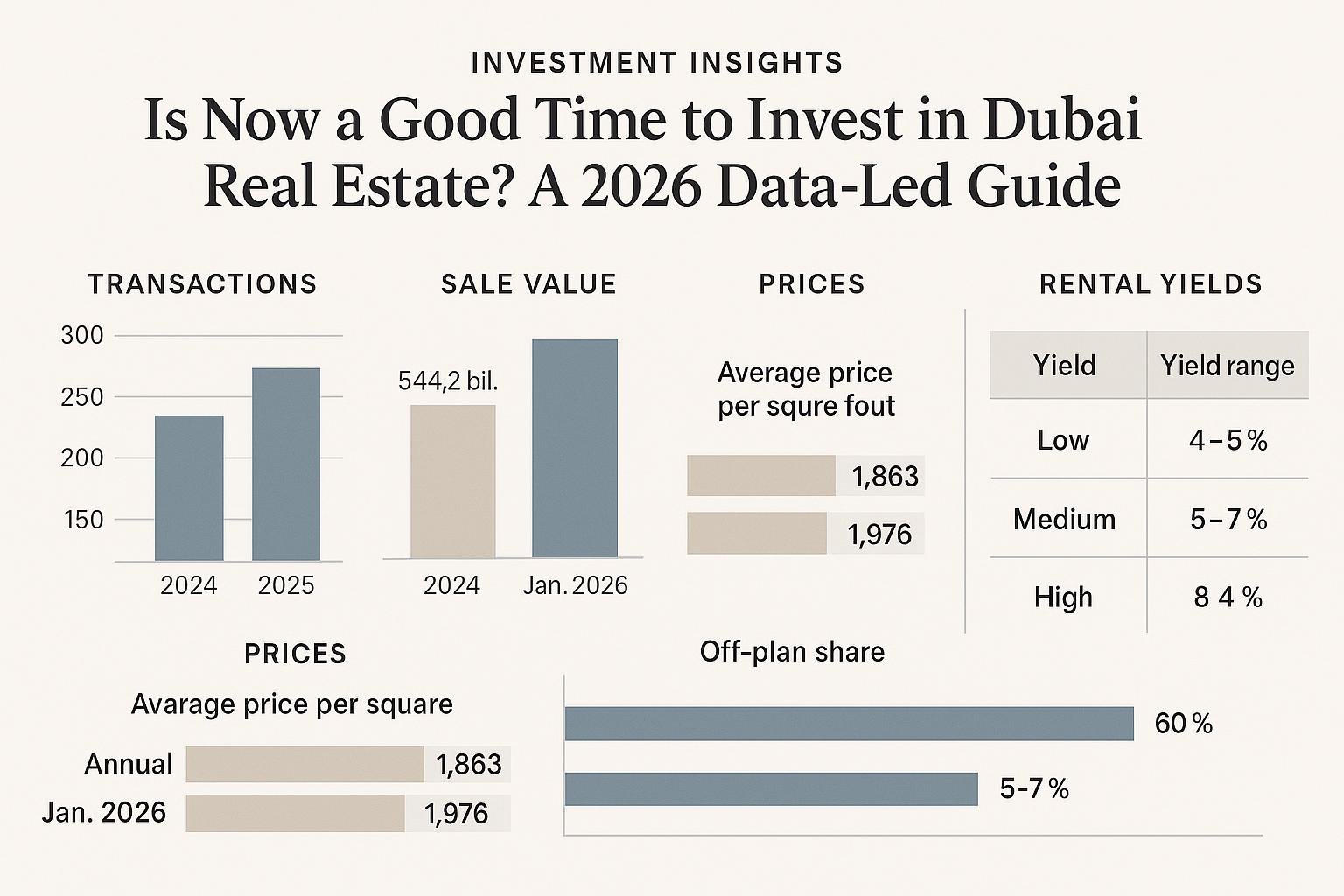
Independent market reviews note that residential transaction values were exceptionally large in 2025, with published figures differing by methodology (residential‑only vs all sales). Specialist research houses report residential values of about AED 544.2 billion in 2025 (Knight Frank) while DLD‑aggregated analyses report broader totals (including some commercial reporting approaches) in the same period that can be higher depending on scope. These differences reflect methodology rather than conflicting underlying activity. (knightfrank.ae)
Market data snapshot (quick comparison)
| Metric | 2024 (baseline) | 2025 | Jan 2026 / Q1 signals |
|---|---|---|---|
| Total registered DLD transactions (approx.) | ~224,994 (2024 DLD total) | ~267,499 (2025, +~19% YoY). | Jan 2026: 16,919 sales reported in one month (strong start). (dxbanalytics.com) |
| Reported total sales value (published) | — | Residential: AED 544.2bn (Knight Frank); wider DLD aggregations reported AED ~682.6bn in some dashboards (method dependent). (knightfrank.ae) | — |
| Average price per sqft (market average) | Lower baseline (2024) | Full‑year 2025 average reported ~AED 1,863/sqft; Jan 2026 monthly average ~AED 1,976/sqft in DLD‑based index. (dxbanalytics.com) | Jan 2026: ~AED 1,976/sqft (DXB Analytics price index). (dxbanalytics.com) |
| Off‑plan share | Growing share | Off‑plan comprised a majority share in many data sets (c. 60%+ by value in some reports); Jan 2026 off‑plan share reported ~64% in DLD‑based indexes. (dxbanalytics.com) | — |
| Typical gross rental yields | Varies by area | Commonly reported ranges: ~4% (prime beachfront) to 8%+ (value neighbourhoods); JVC/International City and parts of Deira commonly show higher gross yields. (propertyindex.ae) | Rents rising in many communities, but yield compression seen where prices rose fastest. (knightfrank.ae) |
Why many investors remain interested (and where)
- Liquidity and transparent transactions: DLD open data and third‑party dashboards provide transaction‑level transparency that helps price discovery and due diligence. (dxbanalytics.com)
- International demand and HNWI flows: Dubai continues to attract global buyers to prime and ultra‑prime stock, supporting the high end of the market. Specialist research highlights strong activity in US$10m+ deals in 2025. (knightfrank.ae)
- Policy tailwinds: residency incentives, zero property tax and a pro‑business environment remain structural advantages often cited by investors and occupiers.
- Rental demand recovery: Several neighbourhoods posted rental growth in 2025 and into Q1 2026, which supports buy‑to‑let strategies where yields and tenant profiles align. (knightfrank.ae)
Risks and watch‑points for buyers
Every market carries risk. For Dubai in 2026, the most commonly cited risks are:
- Supply concentration: multiple sources warn of a large delivery pipeline in 2026 which could create localised oversupply pressure in some communities; UBS and other analyses quantify the potential scale and advise watching completions vs absorption closely. (timesofindia.indiatimes.com)
- Micro‑market segmentation: price and rent behaviour vary sharply by district — prime beachfront and established villa communities behave differently to mass‑market apartment corridors. Broad averages can mask this. (knightfrank.ae)
- Yield compression in prime areas: where capital gains run ahead of rents, gross yields compress — this matters for investors focused on cashflow rather than capital appreciation. (knightfrank.ae)
- Methodology differences: published totals sometimes differ (residential vs all sales; price indices vs asking prices). Use DLD transaction data as the primary factual source. (dxbanalytics.com)
Practical next steps for prospective buyers and investors
If you are considering buying in Dubai now, follow a disciplined checklist:
- Clarify your objective: capital growth, rental cashflow, short‑term flip, or owner‑occupation. Each strategy favours different neighbourhoods and unit types.
- Use verified transaction data: rely on DLD‑based dashboards or professional subscriptions (Property Index, DXB Analytics) to compare actual sale prices, not asking prices. (propertyindex.ae)
- Compare rents vs purchase price to estimate gross and net yields for the exact building and unit. Avoid market averages; compute for the actual floor plan. (propertyindex.ae)
- Check pipeline completions in the same micro‑market — a large near‑term delivery can soften rents and resale values. Knight Frank and DLD‑based trackers publish pipeline estimates. (knightfrank.ae)
- Run scenario stress tests: 5–15% price movement and 0–10% rent movement to see cashflow sensitivity. No one can promise outcomes; scenario testing clarifies risk tolerance.
- Get local professional advice: speak with RERA‑registered agents, read project completion track records and verify title and maintenance history for resale units.
FAQ
Q: Are prices expected to fall sharply in 2026?
A: Leading research in early 2026 points to moderation rather than a sharp collapse. Analysts expect growth to slow and for price momentum to become more selective by neighbourhood and asset type, while some forecasts flag short‑term downside risk where supply is concentrated. Use local data to assess your target micro‑market. (knightfrank.ae)
Q: Which areas typically give higher rental yields?
A: Value‑oriented apartment areas such as parts of JVC, International City and some Deira/Bur Dubai locales commonly show higher gross yields; prime waterfront and central areas typically trade at lower gross yields but with stronger capital appreciation potential. Always calculate on the exact unit and building. (propertyindex.ae)
Q: Should I buy off‑plan or ready‑built in 2026?
A: Off‑plan can offer structured payment plans and potential capital uplift if the project and developer carry low delivery risk. Ready‑built units give immediate rental income and clearer comparables. Given the strong off‑plan share in recent data, weigh developer track record and completion risk carefully. (dxbanalytics.com)
Q: Where can I verify official prices and rents?
A: Use DLD‑sourced dashboards and official Ejari rental contract reports; commercial data platforms that ingest DLD/Ejari provide building‑level price and rental history for due diligence. (dxbanalytics.com)
Data comparison points used in this article
- Annual registered transaction volumes (DLD‑based dashboards).
- Reported total sales value (residential vs broader aggregates).
- Average price per square foot (monthly and annual DLD indexes).
- Off‑plan share by value and volume.
- Typical gross rental yield ranges by neighbourhood type.
Final note: Dubai in mid‑2026 remains a market of opportunity but also of nuance. Strong headline numbers in 2025 do not mean every neighbourhood or product type will perform equally. If you have a clear objective — cashflow, capital growth or residence — start with DLD transaction data for the exact building, stress‑test scenarios and consult a regulated local adviser before committing funds. No analysis can guarantee outcomes; use the data to make informed, risk‑aware decisions. (dxbanalytics.com)
Want help with this Dubai property question?
Share your goal, budget, and preferred area. Real Dubai Deals can help you understand the next practical step.