




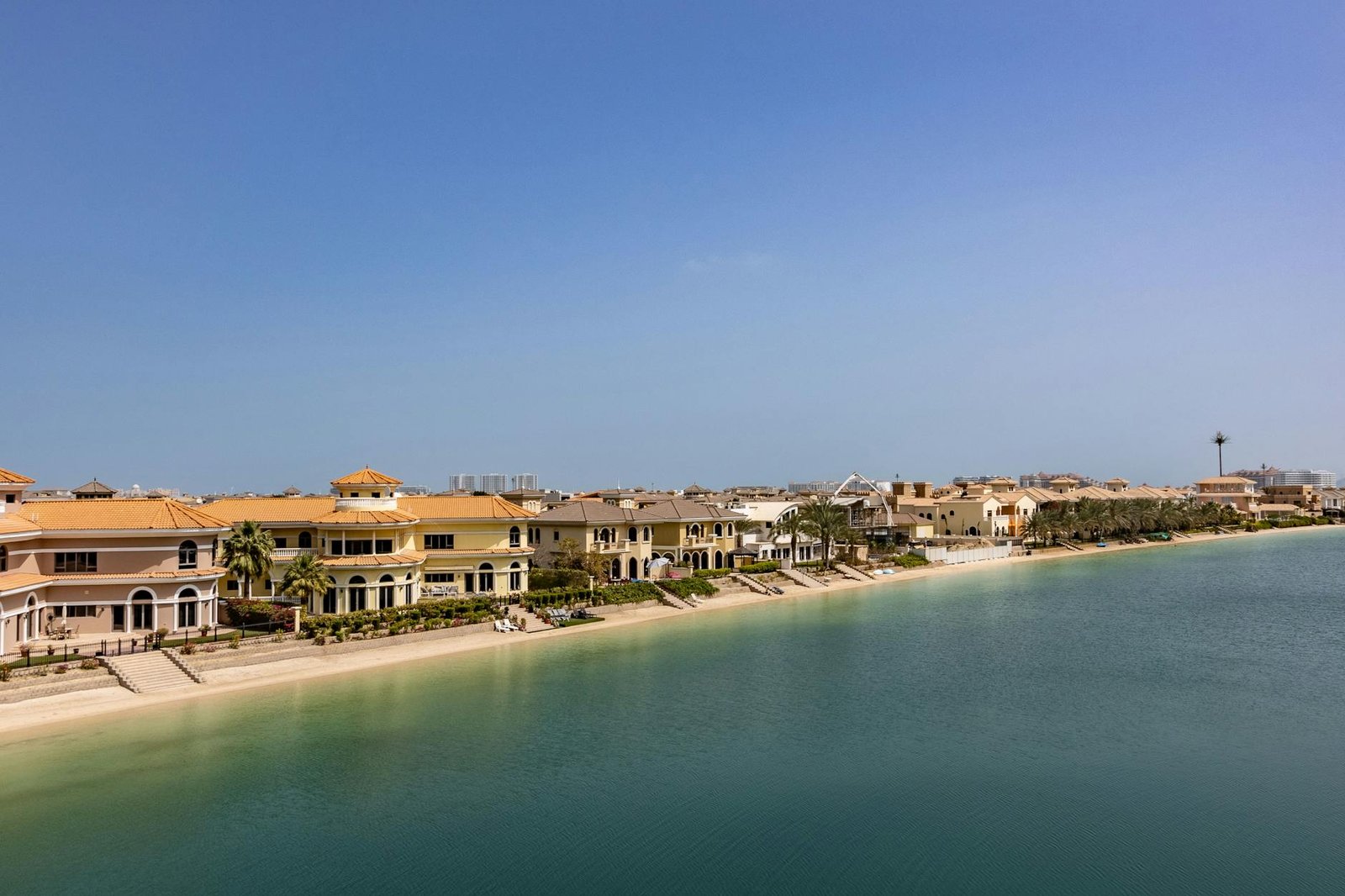
The most common question in Dubai luxury real estate right now isn’t about Downtown or the Marina. It’s about a strip of reclaimed land 30 kilometres southwest of the Burj Khalifa, shaped like a palm tree, and twice the size of the one that made Dubai famous.
Palm Jebel Ali has been in conversation for over a decade. It was announced, paused, revived, and relaunched. Now, in April 2026, it is no longer a concept — 700+ villas have been sold, construction crews are active on multiple fronds, and the first handovers are approaching. The question for investors isn’t whether Palm Jebel Ali is real. It is. The question is whether the Palm Jebel Ali investment 2026 case holds up when you look past the renders and the sales-office enthusiasm.
This is an honest review.
What Palm Jebel Ali Actually Is
Palm Jebel Ali is Nakheel’s most ambitious project since Palm Jumeirah — and it is significantly larger. The development spans 13.4 kilometres in length across approximately 166 square kilometres, making it roughly twice the footprint of its older sibling.
The revised masterplan, relaunched in 2023, is more focused than the original 2002 vision. It concentrates residential supply on 16 fronds, with 723 ultra-luxury villas across the first phase of development. The broader vision includes 80 hotels and resorts, over 35 kilometres of private beach, marinas, a retail district, and a dedicated Friday mosque — a Nakheel first.
The residential product sits firmly at the ultra-luxury tier. Villas come in three primary collections:
- Beach Villas — frond-positioned with direct beach access, 5–7 bedrooms
- Frond Villas — canal-facing, positioned along the frond spine
- Coral Villas — elevated plots with wider canal views
Architects brought in for Phase 2 clusters include SAOTA (South Africa), NAGA Architects, and WATG — names that carry genuine credibility in luxury residential design globally. This is not standard Nakheel product; it is a deliberate step up in design ambition.
Construction Status: The April 2026 Reality Check
This is where many project reviews stop being honest. Let’s not.
As of March–April 2026, Palm Jebel Ali is under active construction, but progress is not uniform across the development. The picture is more nuanced than most marketing materials suggest.
Infrastructure: Marine works, road construction, and shoreline engineering are now more than 50% complete across multiple fronds. Three construction contracts collectively valued at over AED 5 billion were awarded in October 2024 for ultra-luxury villas on the first six fronds.
Vertical construction: Active vertical build commenced in earnest in Q1 2025. As of early 2026, some clusters are in full vertical build, while others remain in earthworks and grading phases.
Handover timeline: This requires careful reading of sources. Nakheel’s official position targets first handovers for late 2026. Independent inspection reports filed with the Dubai Land Department reference completion windows between October 2027 and October 2028 for most tracked units. Nakheel expects infrastructure works to conclude by Q4 2026.
The honest read: early buyers in the most advanced fronds may see handover in late 2026 or early 2027, but the bulk of the community is more realistically a 2027–2028 delivery story. For investors, this matters because your capital is committed through the payment plan, and the rental income clock does not start until handover. Build in a conservative timeline.
If you want to understand how Dubai’s broader villa market is performing ahead of these handovers, our Q1 2026 Dubai property market analysis shows villa prices across the city rising 35.3% year-on-year — the macro tide that Palm Jebel Ali is entering.
The Pricing Case: 60–70% Discount to Palm Jumeirah
The headline number that every sales pitch leads with is, in fact, correct. Current Palm Jebel Ali villa prices — at AED 2,500–2,800 per square foot of built-up area — sit roughly 60–70% below comparable Palm Jumeirah product, which trades at AED 8,000–9,000 per square foot for equivalent villas.
This is not a mirage. It is a pricing gap that reflects a genuine risk premium: an off-plan, unproven address versus one of the world’s most recognised luxury communities. The relevant question is whether that gap will close — and by how much.
Palm Jumeirah’s trajectory provides the reference point. Initial villa buyers on Palm Jumeirah paid around AED 1,200–1,500 per square foot at launch in the early 2000s. Today, equivalent addresses trade at AED 8,000–9,000 — approximately 600–700% appreciation over 20 years. That is an exceptional outcome that almost no other real estate market in the world has replicated.
Will Palm Jebel Ali replicate it? Almost certainly not at the same scale. The starting price is higher, the supply volume is larger, and Dubai’s market is far more mature. But the directional case is intact: a delivered, amenity-rich waterfront address at 65% of Palm Jumeirah’s per-square-foot value is structurally underpriced if the development executes to plan.
Near-term projections from independent analysts model 35–45% capital appreciation from current off-plan prices to post-handover values by 2028, assuming on-time delivery. A villa bought today at AED 25M could appreciate to AED 33M–36M at handover — a range, not a guarantee, and one that assumes execution without material delay.
Palm Jebel Ali ROI: What the Yield Numbers Actually Say
Rental yields on Palm Jumeirah villas currently run at 5–6% gross, compressed by high absolute prices. Palm Jebel Ali ROI projections post-handover point to 7.5–10% gross yields, supported by:
- Lower entry prices relative to the rental demand for luxury waterfront product
- Strong tourist and HNWI rental demand in Dubai — the luxury long-term and short-term rental market has deepened significantly since 2022
- 80 planned hotels and resorts that will create hospitality infrastructure reinforcing the address value of the island
There is an important caveat: yield compression is likely as prices appreciate. Investors buying at current prices lock in the higher yield. Buyers entering after handover, at market prices, will likely see yields normalise toward 5–7% — still excellent by global benchmarks, but below early-buyer projections.
The rental income model also depends on the island being activated: hotels open, beaches accessible, retail and F&B operational. This infrastructure will trail villa handover by 2–3 years. Expect the rental premium to build progressively from 2027 through 2030 rather than materialise immediately at keys-in-hand.
For context on how Dubai luxury property compares to global alternatives from an investment returns perspective, our Dubai real estate vs London, Singapore, and New York analysis explains the structural yield advantage that persists even at the luxury tier.
The Risks Investors Are Not Talking About
Every agent in Dubai will tell you Palm Jebel Ali is a guaranteed winner. Here are the risks that deserve honest attention.
1. Supply scale at handover. 723 ultra-luxury villas in Phase 1 represents a large simultaneous luxury supply event. Palm Jumeirah’s fronds were released over years, allowing price discovery to develop organically. A concentrated handover wave could create short-term softness as supply hits the market before demand absorbs it fully — the classic handover dip.
2. Infrastructure lag. The island’s appeal as a community depends on surrounding infrastructure: the hotels, beaches, retail, and F&B. As of 2026, this is years away from operational completion. Early investors are buying into a community that will not feel like a community for several years post-handover.
3. Connectivity. Palm Jumeirah benefits from proximity to Dubai Marina, JBR, and Sheikh Zayed Road. Palm Jebel Ali’s western location means 35–40 minutes from Downtown Dubai under current road conditions, with no confirmed metro or tram link at this stage. For buyers and tenants who need frequent access to central Dubai, this is a material consideration.
4. Developer execution risk. Nakheel has delivered Palm Jumeirah, Jumeirah Islands, and Ibn Battuta Mall. Their track record is solid. But the original Palm Jebel Ali was shelved entirely after the 2009 global financial crisis. The relaunch has very different dynamics — Dubai’s fiscal position is far stronger and demand is verified — but investors should be clear-eyed that mega-developments of this scale carry construction and delivery risk.
5. Off-plan capital lock-up. Payment plans are typically structured 80/20 (80% during construction, 20% at handover). For an AED 20–30M villa, this is a significant capital commitment before a single dirham of rental income is earned. Liquidity is constrained throughout construction.
Before committing to any off-plan project at this scale, it is worth working through a due-diligence framework. Our guide 18 Parameters to De-Risk Any Off-Plan Project in Dubai covers the key checkpoints, several of which are directly applicable here.
Who Should Buy Palm Jebel Ali — and Who Shouldn’t
Palm Jebel Ali is not the right investment for everyone. Here is an honest framework.
Strong fit for:
- Long-horizon investors with a 5–10 year view and the liquidity to absorb off-plan capital commitment
- HNWIs seeking a flagship Dubai waterfront address at a meaningful discount to Palm Jumeirah pricing
- Buyers who want a genuine waterfront primary residence rather than a pure income-generating investment
- Investors who believe in Dubai’s long-term growth trajectory and want maximum upside exposure in the luxury tier
Less well suited for:
- Investors needing near-term rental income — yields will not materialise meaningfully until 2027–2028 at the earliest
- Buyers seeking a liquid, lower-risk asset — this is illiquid off-plan in a nascent community
- Anyone who may need to exit in 2026–2027, as there may be short-term softness around peak handover supply
- Short-term flippers — the off-plan premium has already been captured by early buyers; the current secondary market is pricing in meaningful future value
What Is Available in April 2026 and How to Access It
Phase 1 villas — across the first six fronds — are largely sold through the primary market, with limited secondary inventory available from early buyers seeking pre-handover exits. Phase 2 clusters designed by SAOTA, NAGA, and WATG are sold out at the primary level.
The next major release is Phase 2B, which is expected to introduce the first apartment clusters on Palm Jebel Ali. Nakheel has signalled this announcement for late 2026. These apartments will represent a lower entry-price point than the villas and are likely to generate strong demand from buyers priced out of the villa tier.
For investors looking to enter today, the practical options are:
- Secondary market villas — available through registered brokers, typically AED 20–35M for 5–7 bedroom Beach Villas. Expect pricing above original launch levels; early buyers are no longer distressed sellers.
- Phase 2B apartment watch — register interest with Nakheel directly or through a registered broker for priority access when the apartment cluster launches in late 2026.
- Ultra-premium plot purchase — a small number of select frond plots have crossed AED 115M. This is a niche play for very high net worth buyers seeking land banking in a prime waterfront address.
The Verdict on Palm Jebel Ali Investment 2026
Palm Jebel Ali is the most compelling large-scale luxury investment story in Dubai right now — but it rewards patience, not urgency.
The investment case is structurally sound: a waterfront address trading at a 65% discount to its older, smaller counterpart, backed by Dubai’s fiscal commitment, Nakheel’s delivery track record, and a masterplan that — when complete — will rival Palm Jumeirah in scale and amenity depth. The macro environment supports it: Q1 2026 data shows Dubai villas appreciating 35.3% year-on-year, and the luxury tier is absorbing capital at pace.
The risks are real and worth naming: construction timelines stretch to 2027–2028 for most units, community infrastructure will lag villa delivery by years, and early buyers in the secondary market have already captured meaningful upside.
For an investor with a five-to-ten year horizon, entry at current prices represents a high-quality asymmetric opportunity. The price gap to Palm Jumeirah is too large to persist indefinitely as the island delivers. For someone seeking immediate income or capital liquidity, Palm Jebel Ali is not the right vehicle.
The window to buy at pricing that genuinely discounts execution risk is narrowing as construction advances and Phase 2B approaches. 2026 is likely to be the last year in which the discount reflects genuine uncertainty rather than confirmed delivery.

