



Introduction
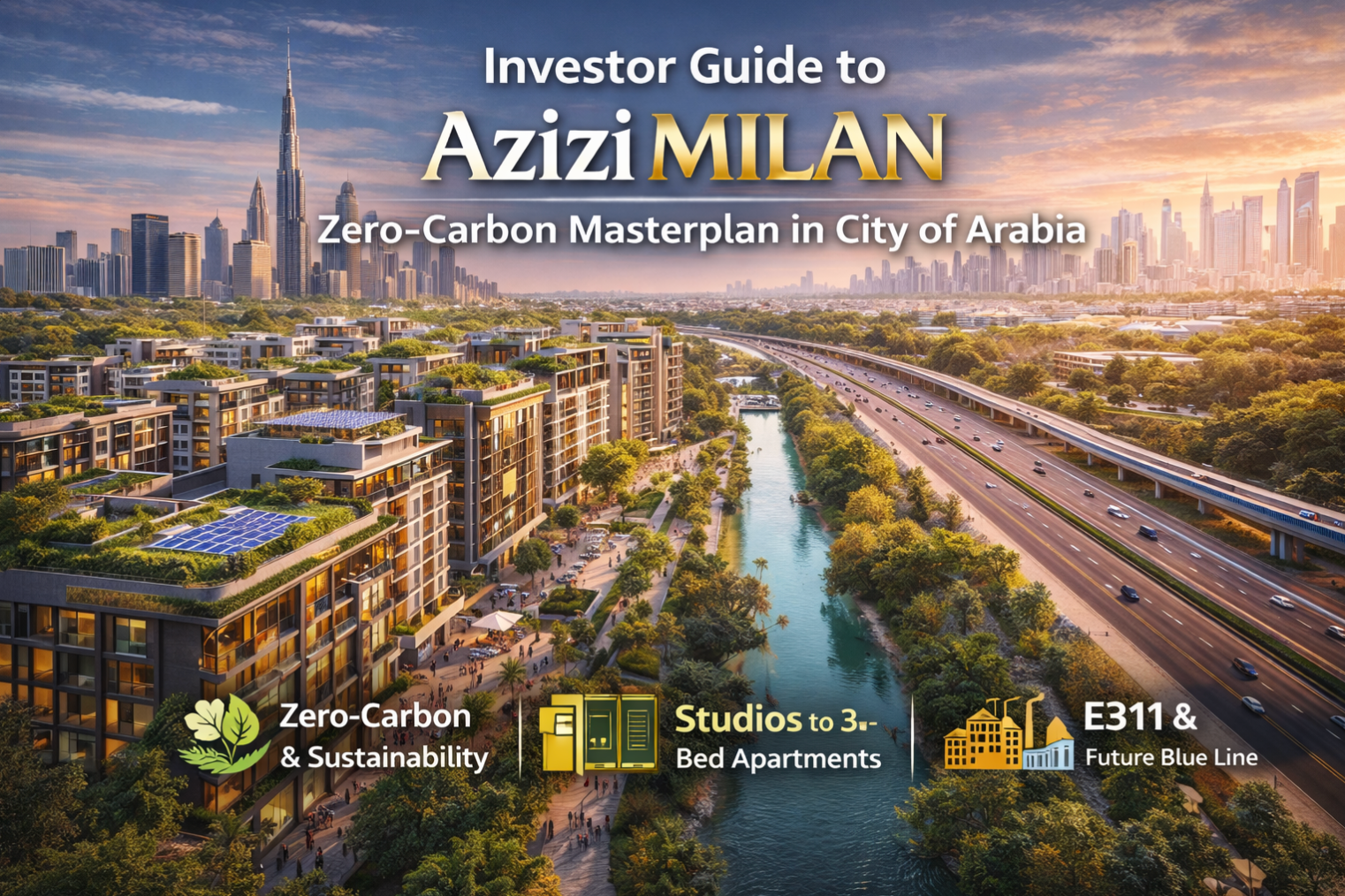
Azizi Milan is positioned as a large-scale, mixed-use community in City of Arabia (Dubailand) that blends Italian-inspired urban design with a sustainability-first narrative. Public reporting frames it as a “zero-carbon” community and highlights the intent to create a fashion-and-lifestyle destination with residential towers, retail boulevards, hotels, offices, and major social infrastructure. Khaleej Times+1
For investors, this is not a single-building story. The fundamentals depend on masterplan delivery, phasing, and the pace at which retail streets, community services, and mobility links become real. Several outlets describe the overall scheme at significant scale—40 million sq ft GFA and a planned population around 140,000–144,000, plus hundreds of hotel keys and large retail components—making it a district-level investment thesis rather than a standalone tower purchase. Gulf News+2Khaleej Times+2
1) Masterplan Scale and Identity
Azizi Milan’s competitive edge is its district-scale ambition. Coverage describes a self-sustaining community with residential projects, a mall, luxury hotels, retail districts, office space, and lifestyle infrastructure (schools, nurseries, mosques, wellness facilities, parks). Khaleej Times+1 That mix matters because mixed-use districts create their own demand gravity once they activate—tenants stay longer when daily life is easier.
Media reporting also explains the urban structure: landmark towers may rise to around 70 storeys, while the central areas are planned as low- to mid-rises in the 25–35 storey range. Khaleej Times+1 This is investor-relevant because it usually creates two rental segments: iconic high-rises that sell lifestyle and views, and more “practical” mid-rises that often trade slightly lower rents for improved livability and cost efficiency.
The “Italian inspiration” is not just a visual theme; it is positioned as a place-making strategy—pedestrian fashion streets, cafés, dining, and nightlife entertainment aimed at creating a recognisable destination identity. Khaleej Times+1 In a masterplan with large unit volumes, identity is a real asset because it supports absorption and resale liquidity as the area matures.
2) Net-Zero Carbon Positioning and Sustainability Claims
Azizi Milan is widely described as a “zero-carbon” or net-zero carbon community, with sustainability presented as a guiding development principle. Khaleej Times+1 Public reporting states the emissions strategy includes supporting carbon-offset initiatives such as landmark mangrove carbon projects and global forest and solar developments certified by VERRA and Gold Standard. Khaleej Times+1
From an investor perspective, this positioning can improve demand, but it should not be treated as an automatic rent premium. “Net-zero” at community scale is often achieved through a combination of design efficiency, renewables, and offsets—not necessarily through low operating costs for every unit. The practical value is long-term: stronger brand perception, broader buyer pool, and potential resale advantage as sustainability becomes a stronger purchase criterion.
Marketing brochures and project collateral also describe tangible green-building features such as energy-efficient systems, solar integration, vertical gardens, and “green roofs on every building,” sometimes framed as a first for Dubai. These claims should be treated as marketing statements until confirmed for the specific building release and specifications. Inside Realty+1 Investors typically protect returns by underwriting based on comparables and service charge realities, while treating sustainability as an upside narrative rather than the core cashflow driver.
3) Unit Mix and What Typically Works for Investors
Azizi Milan is marketed with apartment options from studios up to 3-bedroom layouts, aligned with the standard demand curve in large mixed-use communities. Bayut+1 Inside district-scale masterplans, the most consistently liquid investment formats are usually studios and 1-bedroom units: lower absolute price point, broader tenant pool, faster leasing velocity, and easier resale. Larger 2–3 bedroom units can perform strongly later, once schools, healthcare, retail, and mobility links are fully operational and the area becomes more end-user dominated.
The project’s design narrative emphasises floor-to-ceiling windows and view-oriented positioning (park or canal) across marketed releases such as “Milan Heights.” Inside Realty+1 Views can support rent and resale, but only when future phasing does not obstruct sightlines. In multi-tower districts, “view corridor risk” is real; the investment quality of a unit often depends on stack selection as much as bedroom count.
The investor logic is simple: the best unit is usually the one tenants choose quickly at market rent. That typically means efficient layouts, workable kitchens, sensible storage, balcony usability, and a stack with minimal future obstruction risk. In large supply environments, layout efficiency beats marketing language every time.
4) Amenities and Social Infrastructure as a Retention Tool
Azizi Milan’s amenity narrative is built around “live-work-play” district functionality. Public reporting highlights planned lifestyle infrastructure such as schools, nurseries, mosques, wellness facilities, and parks, plus a mall, hotels, and retail districts. Khaleej Times+1 This is investor-relevant because real rental stability is driven by convenience and tenant retention—not by decorative finishes.
The fashion-and-lifestyle identity is reinforced through plans for pedestrian-only fashion streets, boutique retail, cafés, restaurants, and nightlife venues, designed to make the district feel active beyond working hours. Trade Arabia+1 If executed, this “activation” improves tenant quality and reduces vacancy volatility by turning the community into a destination rather than only a place to sleep.
Project brochures for sub-releases describe resident amenities such as gyms, running and cycling tracks, and social spaces (cinema room, lounges, youth spaces), which align with what mid-market tenants value when comparing newer communities. Inside Realty+1 The critical investor distinction is always scope: some amenities are building-level (impacting service charges directly), while others are masterplan-wide (impacting district desirability). Net returns depend on how those costs and benefits are distributed across the community.
5) Location Fundamentals: E311 Access and the Blue Line Upside
Azizi Milan’s location advantage is repeatedly highlighted in reporting: it is situated on Sheikh Mohammed Bin Zayed Road (E311), positioned for connectivity across Dubai and the northern emirates. Khaleej Times+1 For investors, arterial-road adjacency expands the tenant pool because commute feasibility becomes multi-node rather than tied to a single employment district.
Another major upside narrative is future public transport. Multiple sources state the community is a short walk from the nearest future Dubai Metro Blue Line station. Khaleej Times+1 This should be treated as optional upside until station details and timelines are confirmed, but it is still meaningful: credible metro proximity typically improves long-term liquidity and can support occupancy stability as the area matures.
City of Arabia/Dubailand is a growth-corridor strategy. The opportunity comes from buying into a district that is still forming; the risk comes from timing and competition between phases. In large masterplans, rent performance strengthens when handovers begin, retail streets activate, and infrastructure standards become visible. Location can open the door, but delivery quality decides whether that door becomes sustained demand.
6) Investor Return Drivers: What Can Actually Create Performance
Azizi Milan’s return profile is best understood as a combination of (1) rental cashflow after handover and (2) resale re-rating as the district matures. Reporting describes the project at massive scale with substantial retail and hotel components, which signals an intent to build a destination rather than a purely residential zone. Gulf News+1 District maturation tends to create price compression against established areas once public realm quality, retail convenience, and mobility links become credible.
Rental performance in large communities is usually driven by fundamentals: competitive rent pricing, layout efficiency, service charges, and tenant experience. Branding (Italian lifestyle, zero-carbon narrative) supports demand, but it rarely carries rent by itself. Sustainable positioning can widen buyer and tenant interest, but underwriting should still be based on realistic comparables and net yield after operating costs.
Resale upside often materialises in phases: early handover confidence, visible retail activation, and demonstrably strong building management standards. When these elements are present, end-user demand typically increases, improving liquidity. The disciplined investment posture is to assume base-case rent and modest appreciation, then treat any transit progress or major retail activation as upside—not as a requirement for the deal to work.
7) Payment Plan and Due Diligence That Protects Net Returns
Azizi Milan is promoted with flexible payment structures across different releases, often framed as investor-friendly. The risk is not the headline; it is the contract detail. Effective due diligence centres on verifying the SPA schedule, penalties, grace periods, and what “completion” actually includes (handover documentation, snagging timeline, defect liability period).
Key investor checks typically include: exact building and release identification, expected handover window, unit specifications (kitchen scope, wardrobes, appliances if applicable), parking allocation, balcony size, and any smart-home inclusions. Leasing rules matter: long-term vs short-term permissions, holiday home restrictions, and any community policies that impact tenant targeting.
Service charges are often the silent deal-breaker. In high-amenity mixed-use districts, service charges can materially alter net yield. The practical approach is to request the best available estimate and understand what is included at building level vs masterplan level. Phasing risk also requires attention: view corridors and future plot positions around the building can affect resale and rental pricing. Sustainability features such as rooftop gardens or green roof narratives should be confirmed per building release rather than assumed across the entire district. Arabian Business+1
Conclusion
Azizi Milan is a high-ambition, district-scale project in City of Arabia with a strong identity narrative: Italian-inspired design, fashion streets and mixed-use depth, positioned as a contemporary zero-carbon community with an offsets strategy tied to VERRA and Gold Standard-certified initiatives. Khaleej Times+1 Reporting highlights major scale (around 40 million sq ft GFA, population targets in the 140k–144k range, and hundreds of hotel keys) and a strategic location on E311 with a future Blue Line metro proximity narrative. Gulf News+2Trade Arabia+2
For investors, the project’s attractiveness depends on disciplined selection and timing. The strongest early-cycle rental liquidity typically sits in studios and 1-bedroom units, while larger layouts often benefit later as schools, healthcare, retail, and public realm mature. Sustainability and lifestyle branding can support demand, but net performance will still be driven by unit efficiency, service charges, vacancy control, and building management quality.
Azizi Milan can become a durable growth-corridor asset if masterplan delivery and activation match the narrative. The investment case is strongest when the deal works under conservative rent assumptions, with infrastructure and transit progress treated as upside rather than a dependency.