




Introduction
Azizi Riviera Phase 4 sits inside one of Dubai’s most talked-about mid-market waterfront communities: Azizi Riviera in District 7 of Mohammed Bin Rashid City (MBR City), Meydan. The broader Riviera concept is positioned around a Mediterranean-inspired lifestyle with promenades, waterways, and walkability—an approach that typically supports steady tenant demand when the product is priced correctly. Third-party market guides describe Riviera as a freehold waterfront community with a wide mix of studios and apartments, designed to appeal to professionals, couples, and small families who want proximity to central Dubai without paying Downtown-level pricing. Kredium
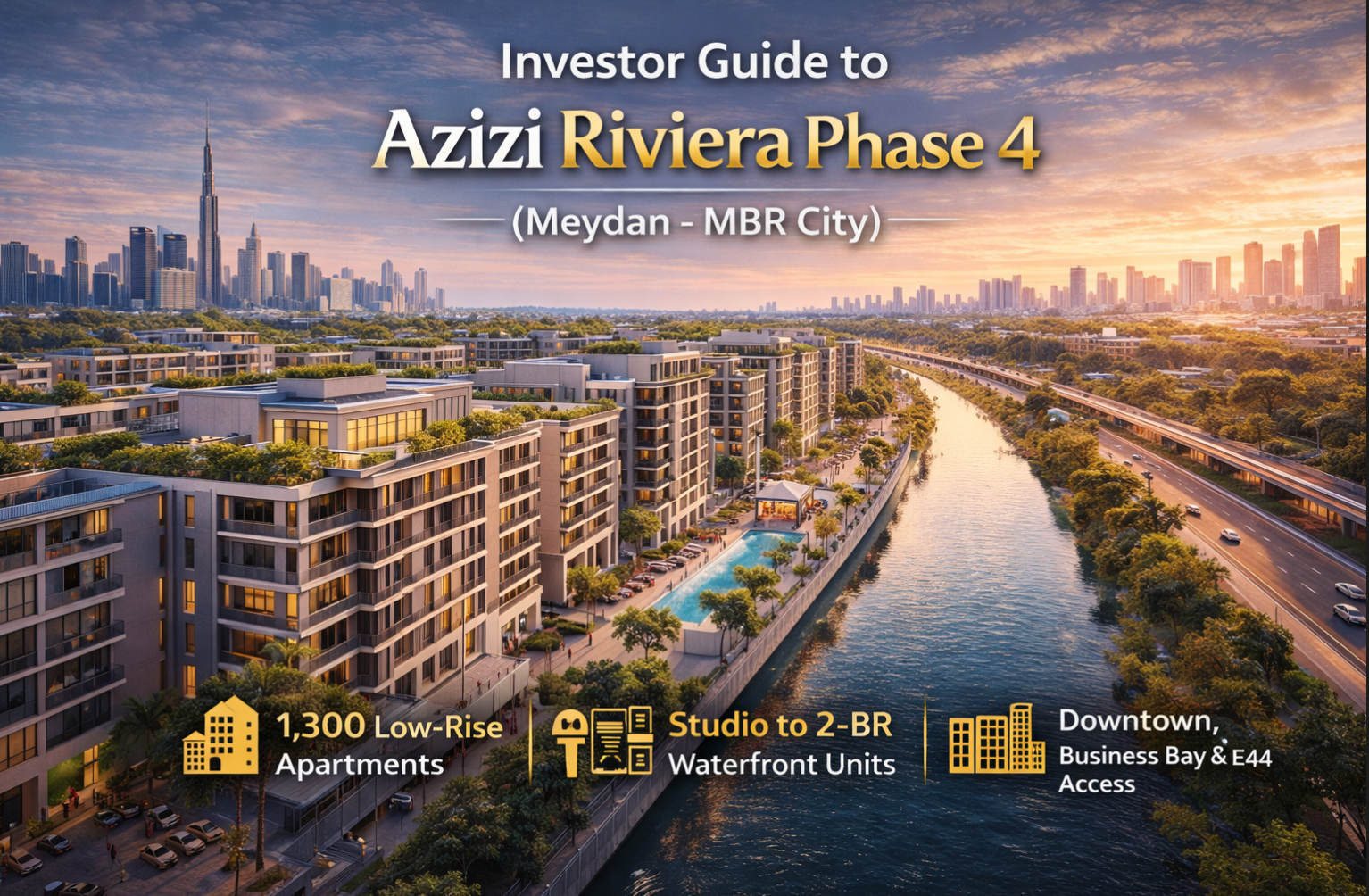
Phase 4’s investment angle is practicality: it’s not a “future promise” only. Listings and market portals describe Phase 4 as a completed cluster (reported completion around July 2024), with around 1,300 units across low-rise buildings (reported 8 floors)—which can be attractive for investors who prefer lower density and easier day-to-day building operations versus very tall towers. FazWaz
1) Investment Snapshot: What Phase 4 represents
Phase 4 is commonly presented as a ready / recently completed portion of Azizi Riviera rather than a long-dated off-plan bet. Market portals describe it as a condo/apartment project in Azizi Riviera, completed in July 2024, with about 1,300 units across 8 floors. FazWaz+1 That matters because “completion risk” drops significantly once a phase is delivered—leasing becomes execution (pricing, marketing, management), not speculation.
The wider Riviera masterplan is large, with community guides describing it as spanning 70+ mid-rise residential buildings and integrating retail at podium/ground level across many buildings. Kredium In big masterplans, the best-performing buy-to-let units are usually those that match the largest tenant pool and remain easy to resell—typically studios and 1-bedroom units—while 2-bedroom units can work well once the community matures and family demand strengthens.
Phase 4’s “low-rise, many-units” profile is best suited to investors looking for:
- faster move-in readiness compared to early off-plan launches
- stable mid-market leasing rather than luxury volatility
- a community story strong enough to compete (waterfront + lifestyle) without relying on hype
2) Location and Connectivity: Why MBR City (Meydan) keeps demand broad
Azizi Riviera is described as being located in District 7 of MBR City, positioned near Meydan Racecourse, and connected via major routes such as Al Khail Road (E44)—with community guides highlighting access to key Dubai hubs including Downtown Dubai, Business Bay, and Dubai Marina. Kredium For investors, this connectivity is the core demand driver: it expands the tenant pool beyond a single employment zone.
Third-party area guides also present practical commute benchmarks (approximate): Meydan Racecourse (~5 minutes), Business Bay (~10–12 minutes), Downtown (~15 minutes), and Dubai International Airport (~25–30 minutes). Kredium These are not guarantees, but they reflect why Riviera remains attractive: it offers a waterfront lifestyle close to central Dubai while typically sitting below the price pressure of the most prime districts.
For leasing strategy, this location usually pulls:
- professionals working in Business Bay / Downtown / DIFC who want a newer unit
- couples seeking lifestyle amenities and walkability
- tenants prioritizing accessibility via major roads without paying premium beachfront rates
In short: Riviera’s positioning is “central-enough to rent” with a community identity that helps listings stand out.
3) Unit Mix and the clean investor approach
Phase 4 availability is commonly shown as studio, 1-bedroom, and 2-bedroom apartments. FazWaz+1 That mix is investor-friendly because it matches typical Dubai leasing demand curves: studios and 1BRs are usually the fastest movers; 2BRs can command stronger absolute rent but may require sharper pricing discipline.
The unit strategy inside a large community is not about “best view on paper”—it’s about rentability:
- Efficient layouts (usable living space, workable kitchen, storage) beat fancy finishes.
- Balcony practicality matters more than balcony size.
- Stack selection matters because future buildings can affect light and outlook.
Phase 4’s reported low-rise nature can be an advantage for tenants who dislike mega-tower congestion (lifts, parking, crowding). It can also simplify maintenance and reduce operational friction—important for investor experience over time.
A disciplined investor approach typically prioritizes:
- studios / 1BR for maximum liquidity and leasing velocity
- units with clean internal layouts over awkward “designer” shapes
- stacks less exposed to future obstruction (confirmed via the broader masterplan)
4) Amenities and resident retention: what supports occupancy
Riviera is marketed as a resort-style waterfront community, with landscaping, promenades, and lifestyle facilities designed to keep residents in place. Community guides describe Riviera’s environment as built around waterways, walking trails, parks/playgrounds, and integrated retail/dining—features that improve retention because daily life becomes convenient. Kredium
For Phase 4 specifically, portals list core building amenities such as a communal pool and communal gym. FazWaz These may sound basic, but they are the “minimum viable” amenities tenants expect in modern Dubai mid-market communities. When a building meets these expectations, the leasing conversation becomes simpler and the unit competes on price, layout, and location—rather than on missing essentials.
Retail integration matters as well. Area guides note that Riviera includes podium/ground-floor retail in many buildings—cafés, supermarkets, and daily services—which boosts walkability and reduces tenant churn. Kredium
Investor takeaway: amenities don’t create rent premiums by themselves; they reduce vacancy risk and protect rental stability—especially in communities with high competing supply.
5) Rental demand and yield logic: where the numbers usually work
Riviera is often positioned as a mid-market waterfront alternative to more expensive central districts. Market guides cite gross yields in the area in the range of ~6% to 7.5% (varying by unit type, building, and purchase basis). Kredium These are not guaranteed returns, but they reflect why buy-to-let investors consider Riviera: demand is broad, and the entry price can sit below prime waterfront locations.
The most consistent tenant segments in communities like Riviera tend to be:
- young professionals and couples seeking proximity to Business Bay/Downtown
- tenants who want newer finishes and amenities without high luxury pricing
- small families (more relevant for 1BR+ and 2BR units)
What usually decides performance is not headline rent—it’s net yield after:
- service charges
- vacancy / leasing fees
- maintenance and furniture replacement (if furnished)
This is why Phase 4 being reported as completed is meaningful: it enables real underwriting based on actual leasing and operational costs, rather than forecasts.
6) Payment structure: treat it as variable, not fixed
Payment plans for Riviera vary by building, release timing, and the seller’s situation (developer stock vs resale). Publicly published examples show multiple plan formats, including:
- a staged plan ending with 70% on completion (with early instalments around booking) Tanami Properties+1
- a simplified 20/80 plan in some published options Tanami Properties
These are useful reference points, but they are not universal. The only numbers that matter are the ones written in the SPA / sale contract for the specific unit.
For investors, the cashflow logic is straightforward:
- shorter plans reduce long-term exposure but require higher near-term cash
- longer structures can improve flexibility, but only if rent can support holding costs
Phase 4’s “completed” positioning often means payment terms may be less “developer-style” and more dependent on seller terms and bank financing availability, especially in the secondary market.
7) Investor due diligence that actually protects returns
Phase 4 can be attractive, but the wrong unit can still underperform. The non-negotiables for due diligence:
- Service charges: get the best available estimate and check what is included. Net yield lives or dies here.
- Building management quality: ask about maintenance standards, response times, and common-area upkeep.
- Handover condition and snagging (if newly handed over): verify defect liability and what is covered.
- Leasing rules: confirm whether short-term leasing is permitted and any community restrictions.
- Parking allocation and access: small details that influence tenant satisfaction.
- Unit efficiency: layout, storage, kitchen usability, noise exposure, and view/light.
One hard truth: Riviera has large supply across many buildings. That means pricing discipline matters. The best units win because they rent faster at market rates, not because they were marketed hardest.
Conclusion
Azizi Riviera Phase 4 is best understood as a practical, mid-market waterfront investment inside MBR City (Meydan), backed by strong connectivity and a community lifestyle narrative that tenants recognize. Area guides place Riviera in District 7 of MBR City, near Meydan and connected via Al Khail Road (E44) to major Dubai hubs—supporting broad rental demand. Kredium
Phase 4 is repeatedly described on market portals as a completed low-rise cluster (reported July 2024 completion) with around 1,300 units and essential resident amenities such as a communal pool and gym. FazWaz That combination suits investors who prefer reduced delivery risk and want to focus on execution: unit selection, pricing, tenant profile, and cost control.
The winning approach is not complicated: prioritize rentability, protect net yield by understanding service charges, and avoid units with compromised layouts or weak light/view outcomes. Riviera can perform well when bought correctly—especially in studios and 1-bedroom formats—but it will punish lazy underwriting because supply is real and competition is constant.