




Introduction
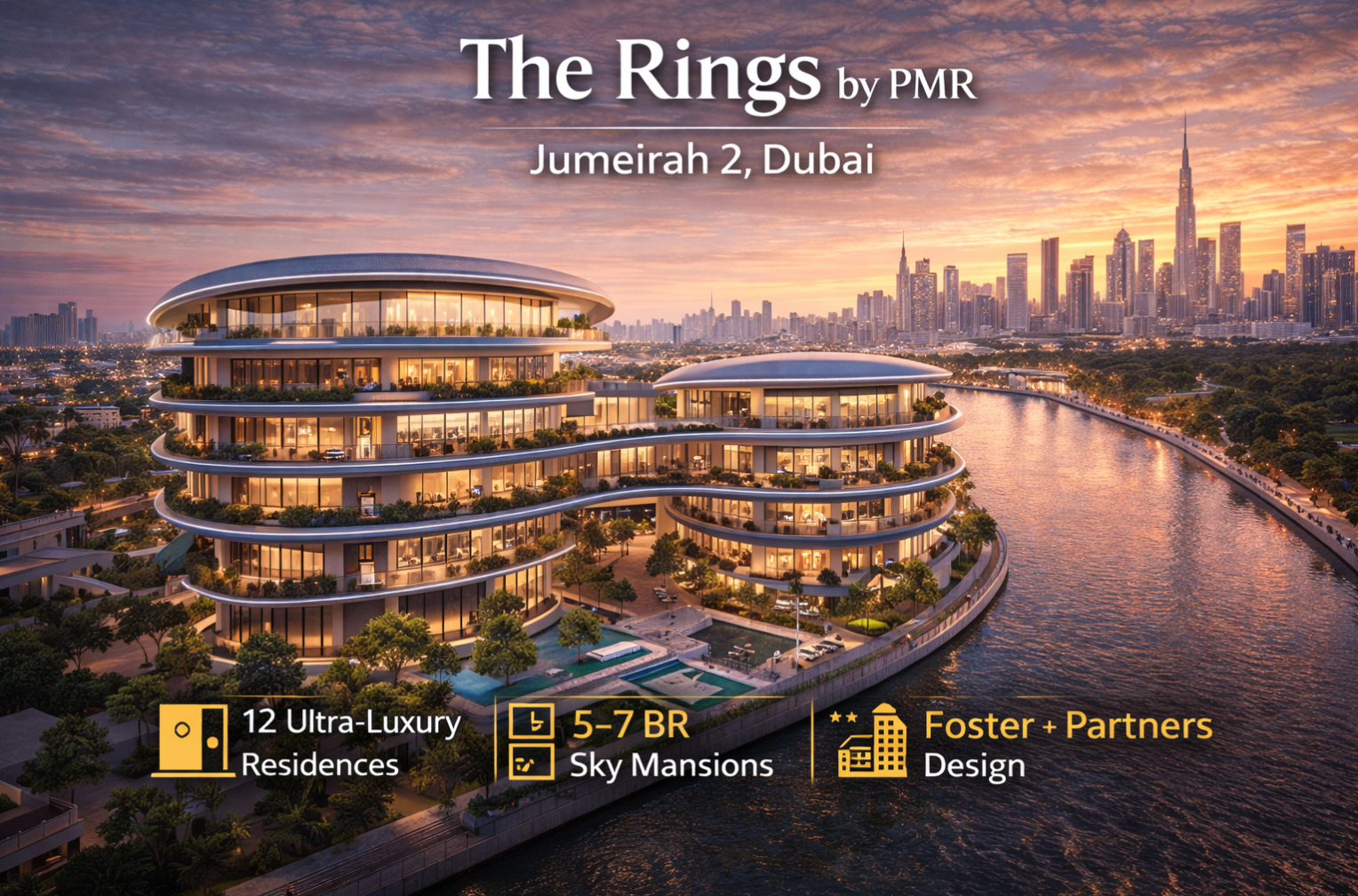
The Rings by PMR is a hyper-luxury, ultra-low-supply residential project on the Dubai Water Canal in Jumeirah 2, designed by Foster + Partners. (Foster + Partners) Unlike conventional tower launches, The Rings is positioned as a “collector-grade” asset: two low-rise buildings with only 12 residences total, marketed as Sky Mansions and Sky Palaces with canal and skyline views. (Bayut)
For investors, the story is not about mass-market yields. It’s about scarcity, brand-grade design authorship, privacy, and service-led living in an established prime district. Foster + Partners’ project page frames the location as Jumeirah’s waterfront canal district, close to landmarks such as Safa Park, Downtown, and Jumeirah Beach, reinforcing the “prime + connected” positioning. (Foster + Partners)
This article breaks down The Rings as an investment asset: what is being delivered, why the limited inventory matters, how the product is differentiated (private lifts, garages, in-residence facilities, 5-star services), the payment structure reported by major portals, and the due-diligence checks that protect capital at this pricing tier. (PMR Property)
1) Project Snapshot: What is actually being delivered
The Rings is described across major portals and the developer’s materials as a two-building, low-rise canalfront development with just 12 residences—a scale that immediately separates it from Dubai’s typical luxury supply. (Bayut) The unit mix is positioned in the topmost ultra-luxury bracket: 5–7 bedroom residences, widely marketed as Sky Mansions and Sky Palaces. (Property Finder) Sotheby’s project page lists the area range at roughly 9,612 to 19,122 sq. ft., underscoring that these are “full-floor feel” homes rather than typical apartments. (Sotheby’s International Realty)
Design authorship is a major value driver here. Foster + Partners publicly lists The Rings as “under construction” and positions it as a development that aims to redefine luxury living on the canal with skyline views. (Foster + Partners) PMR’s official site also markets private lifestyle features and hotel-style services as core to the product identity. (PMR Property)
At an investment level, this structure signals scarcity value: the primary competition set is not “other off-plan towers,” but a small group of ultra-limited, architect-led trophy residences along the canal and prime coastal districts.
2) Design and Scarcity: Why Foster + Partners + 12 units changes liquidity
In ultra-luxury, scarcity is not a marketing slogan—it is the asset. The Rings’ 12-residence total supply creates a fundamentally different liquidity profile versus projects with hundreds of units. (Bayut) Low supply tends to support value stability because resale pricing is less exposed to internal competition (“same building, cheaper unit”) and more dependent on external demand from high-net-worth buyers seeking specific attributes: privacy, authorship, and uniqueness.
Foster + Partners’ public association matters because it functions as global design validation; the firm’s own project page frames The Rings as a luxury benchmark in Jumeirah’s canal district with major landmark proximity. (Foster + Partners) In practice, projects with globally recognized design authorship can hold attention through market cycles, especially when combined with a low unit count.
This is not a “volume investor” product. It’s closer to a trophy asset strategy where the expected performance is driven by:
- capital preservation in a prime location,
- long-term resale optionality to end users/collectors, and
- extreme product differentiation that reduces substitutability.
At this tier, execution matters more than macro headlines. Delivering the architectural promise, management standards, and service culture is what turns scarcity into sustained value.
3) Residence Experience: Private lifts, garages, and in-home lifestyle facilities
The Rings is marketed around privacy and “house-like” control within a residence format. Multiple sources describe features such as private elevators and residence-level amenities that go far beyond typical luxury towers. (The Rings) PMR’s official site highlights private lifestyle components (e.g., private gym) and positions the project under a 5-star services umbrella including 24/7 luxury concierge, chauffeur service, bellboy, and housekeeping. (PMR Property)
Third-party project pages also describe exceptionally private configurations—such as a dedicated elevator and expansive layouts—reinforcing that these are “estate-style” residences, not conventional apartments. (The Rings) The investment implication is straightforward: the product is built to appeal to buyers who typically compare against standalone beachfront/canal villas, but prefer the security and service structure of a managed residence.
At this pricing tier, differentiation must be real. The Rings’ positioning is aligned with what drives ultra-prime demand in Dubai: privacy, exclusivity, service consistency, and a residence that feels curated rather than mass-produced. When those elements are executed properly, resale demand can be less price-sensitive than in mainstream luxury inventory.
4) Location: Dubai Water Canal + Jumeirah 2 prime residential context
Jumeirah 2 is an established prime district, and canalfront positioning adds an additional “blue-line” premium: view value, lifestyle value, and scarcity along a limited waterfront edge. Foster + Partners frames the project as located in the Jumeirah district of the Waterfront Canal development, offering canal and skyline views, and close proximity to Safa Park, Downtown, and Jumeirah Beach. (Foster + Partners) That combination—waterfront setting + central landmark access—is exactly what supports capital preservation in Dubai’s prime market.
In rental terms, this is not a mass tenant pool product. Leasing demand (if used) typically comes from: high-income executive tenants, corporate housing demand, diplomatic profiles, or short-term luxury stays depending on building rules and management structure. The larger investment thesis remains end-user resale and long-hold value stability rather than yield-chasing.
The canalfront context also helps differentiation: many “luxury” units compete on finishes, but fewer can compete on a waterfront edge with globally recognized design authorship and a 12-unit supply constraint. The location works as a value anchor, while the product features and scarcity work as the premium multiplier.
5) Price Positioning and Buyer Profile: Treat it as a trophy-asset strateg
Public portals repeatedly list starting prices in the ultra-prime band. Property Finder’s new project page and multiple market listings reference a starting price around AED 59 million. (Property Finder) At that level, the buyer universe is inherently narrow—and that’s the point. The Rings is designed for capital concentration rather than affordability.
This category behaves differently from mainstream off-plan. Market depth is lower, transaction volume is lower, but individual deal sizes are higher and price sensitivity can be lower if the asset is truly unique. The investor logic is closer to “trophy inventory”: the goal is holding a rare asset that remains desirable to a small but consistent class of global and regional buyers seeking the most private, design-led residences in prime Dubai.
Returns in this segment are usually driven by timing (delivery, market cycle peaks), credibility of the delivered product versus renders, and resale narrative strength (design authorship + scarcity + location). Yield is secondary; net operating costs and service charges can be high, and the property is often held for lifestyle use plus value preservation.
6) Payment Plan and Delivery: What major portals report
Several mainstream portals report delivery in Q4 2025 / December 2025 for The Rings. (Property Finder) Property Finder’s new project page states a delivery date in December 2025 and describes the payment structure as 5% down payment, 55% during construction, and 40% upon handover. (Property Finder) Bayut’s building guide also references an expected completion date of Q4 2025 and notes a 60/40-style structure (with booking and construction instalments and a final handover portion). (Bayut)
At this segment, the headline plan is not the decision factor—the enforcement of milestones and clarity of the SPA schedule is. Construction-linked schedules reduce ambiguity when milestone definitions are precise. A final large handover portion can protect buyers if delivery timelines slip, but only if contract clauses are clear and enforceable.
The most important point: payment schedules can vary by unit and sales period. The only binding schedule is the one written in the SPA and appended payment plan for the specific unit.
7) Investor Due Diligence: Non-negotiables at ultra-prime pricing
Ultra-prime capital needs ultra-prime diligence. The Rings’ marketing is heavy on service and privacy, so verification must focus on operational reality: building management structure, service scope (what is included vs paid add-ons), and service charge expectations. PMR’s official site explicitly lists service elements such as concierge, chauffeur, bellboy, and housekeeping—these must be validated contractually and operationally. (PMR Property)
Key checks that protect downside:
- Escrow and project compliance (developer’s official materials reference an escrow account). (PMR Property)
- Delivered specifications vs marketing claims (finishes, appliances, private lift access, garages).
- Completion definition (handover readiness, snagging, defect liability period, rectification timelines).
- Leasing permissions (long-term vs short-term rules, holiday-home eligibility, community policies).
- Service charge model and what it includes—critical for net holding costs.
- Privacy/security protocols (access control, visitor management, staff service standards).
In ultra-luxury, poor operations destroy premium faster than market cycles. The asset performs when the delivered experience matches the promise.
Conclusion
The Rings by PMR is positioned as a rare canalfront trophy asset: 12 residences total, 5–7 bedroom ultra-large layouts, Foster + Partners authorship, and a service-led living proposition in Jumeirah 2 on Dubai Water Canal. (Foster + Partners) Major portals report a December/Q4 2025 delivery window and a staged payment structure that concentrates a large portion at handover, reinforcing the importance of SPA clarity and milestone definitions. (Property Finder)
As an investment, this is not a yield-first play. It is a scarcity-first, capital-preservation strategy that relies on: location strength, design authorship, delivered quality, and operational excellence. When those variables align, ultra-low supply can support value stability and resale optionality. When they don’t, premium pricing becomes vulnerable.
The Rings belongs in the category of Dubai’s most private, design-led waterfront residences. The determining factor is execution—contract detail, delivery quality, and management standards—because that is what turns a trophy narrative into an enduring asset.