




When a real estate investor evaluates global opportunities, the decision is seldom about “which city is best” in absolute terms. Rather, it comes down to trade-offs: yield vs safety, growth vs stability, regulatory ease vs market size. In recent years, Dubai has emerged as a compelling option in that trade-space. How does it stack up against major real estate markets around the world—from London and Tokyo to India, Canada and beyond? Below is a comparative analysis structured around the key metrics investors care about, and a city-by-city breakdown to illuminate where Dubai shines—and where it must compete.
Key Investment Metrics & How Dubai Performs
1. Entry Cost & Affordability
A lower price per square meter (or per unit) makes it easier to deploy capital, diversify, and absorb risk. Dubai often offers a lower barrier to entry compared to top-tier global cities. Many prime global cities (London, Tokyo, Singapore, Vancouver) command sky-high land costs, heritage constraints, and limited land supply, pushing property prices into the ultra-high bracket.
2. Rental Yield / Cash Flow
One of Dubai’s most frequently cited advantages is stronger yields. As of mid-2025, average gross rental yields in the UAE hover around 4.87% (for the country overall) Global Property Guide, though many Dubai-specific sources claim yields between 5–9 % or even up to 10 % in prime neighborhoods Shielded Homes. For example, some developers and analysts report Dubai yields of 6–8 % or more Invest in Dubai Homes.
By comparison, in mature markets:
- London: yields often in the 2–4 % range (sometimes lower in prime districts) Taraf Holding
- New York / U.S. prime: 3–5 % or lower in many central locations
- Singapore: yields often under 3 % in many segments haus & haus
- Moscow / Russia: lower yields in many central locations (often suppressed by regulation or price levels)
- India / Pakistan: yields vary widely by city and area, sometimes relatively high (especially in secondary or suburban areas) but often offset by regulatory risk, tenant defaults, or vacant periods
- Turkey / Istanbul: moderate yields depending on neighborhood and macro risk
- Canada: yields in major cities like Toronto and Vancouver tend to be low (e.g. 2–4 %) due to high entry prices
Hence, for investors seeking cash flow, Dubai often outperforms mature global peers (though net yield after costs, taxes, vacancy and maintenance must be carefully calculated).
3. Capital Appreciation Potential
Yield is one thing; price growth is another. Dubai has seen robust price increases in recent years: e.g. a reported 20.7% year-on-year rise in residential prices up to March 2024 QBD. Some projections and developer commentary place annual appreciation in the 5–7 % range Shielded Homes.
In comparison:
- London: capital growth tends to be modest, perhaps 2–4 % in stable periods (but with high volatility)
- Tokyo: relatively stable appreciation; Japan’s real estate is less volatile and often more safe, though growth is slow
- Singapore: stable but not spectacular growth, often 3–4 %
- China / Shanghai: a boom-and-bust history; regulatory interventions frequently affect growth
- India / Pakistan: potential for high growth, but risk is high and growth is uneven
- Turkey: inflation and currency depreciation may distort nominal growth
- Saudi Arabia: emerging market, with high upside potential if reforms and infrastructure succeed
- Canada: stable growth in many parts, though major cities face affordability constraints
So Dubai offers a balanced middle ground: stronger growth potential than many mature markets, but less risk (in certain respects) than some frontier markets.
4. Taxation & Transaction Costs
This is a major differentiator.
- Dubai (and UAE more broadly) imposes no property tax, no capital gains tax, and no personal income tax on rental income (for individuals) in many cases. kamaniliving.com
- In many other jurisdictions:
- UK / London: there are property taxes, stamp duty, capital gains tax (depending on ownership structure)
- Singapore: various property transaction taxes, stamp duties, sometimes seller’s stamp duties
- Canada: capital gains tax, land transfer tax, annual property taxes
- India / Pakistan: multiple taxes (stamp duty, registration, maintenance, property tax, sometimes capital gains tax)
- Turkey: property tax, transaction tax, capital gains tax rules
- Russia: property and capital gains taxes (depending on ownership period)
- Saudi Arabia: depends on reforms, but foreign-owner taxation may evolve
- China: heavy transaction costs, stamp duties, tax regulations
Those tax advantages in Dubai improve net returns significantly, especially in yield-driven strategies.
5. Regulation, Ownership Rights & Transparency
Another critical factor. You want to feel secure in your ownership rights, dispute resolution, title clarity, and regulatory protections.
Dubai has structured much of its property market around “freehold” zones where foreigners can own property outright. The Dubai Land Department and Real Estate Regulatory Authority (RERA) have introduced rules to increase transparency and consumer protection. Keltandcorealty Some observers caution that regulation is still evolving and enforcement varies.
In contrast:
- London / UK: mature legal framework, strong title systems, good transparency
- Tokyo / Japan: strong legal certainty and mature markets
- Singapore: highly regulated, transparent, strong protections
- China: more opaque. Ownership is typically leasehold (e.g. 70-year usufruct) rather than freehold, and government intervention is possible
- India / Pakistan: often problems with clear title, overlapping claims, regulatory delays, disputed ownership
- Turkey / Russia: regulatory risk, changes in foreign ownership rules, sometimes opaque processes
- Canada: mature markets with high regulatory standards
Dubai often offers better ease of entry and clarity than many emerging markets, though it does not (yet) match the legal depth of the most mature real estate systems.
6. Liquidity, Market Depth & Risk
A highly investable market needs depth so you can buy or exit without excessive price impact.
Dubai has grown very fast, with many new developments and a rising volume of transactions. However, it’s still smaller in global scale relative to London, Tokyo, Shanghai, etc. In a downturn, Dubai may see sharper corrections (especially in speculative segments) because the market is still maturing.
Mature global cities offer deeper capital pools and stronger institutional presence, which buffers volatility to some extent.
7. Macroeconomic Drivers, Population / Demand Growth
Real estate is ultimately driven by demand: population growth, urbanization, business activity, tourism, foreign migration, etc.
Dubai benefits from aggressive economic diversification, tourism, status as a global hub connecting Asia, Europe and Africa, and policies that promote foreigner attraction. Its strategic geographic location helps. stradauae.com
Other cities:
- London: global financial and cultural hub, stable demand
- Tokyo: stable but aging population, slow growth
- Singapore: strong demand, limited land supply
- Shanghai / China: strong urban demand but regulatory risk
- India / Pakistan: strong population growth, urbanization, but infrastructure constraints
- Turkey: bridging Europe and Asia, high potential but also volatility
- Russia: demand tightly linked to political risk and capital flows
- Canada: immigration policy supports population growth, especially in major cities
Thus, Dubai competes well on demand-side fundamentals in the region.
8. Currency Risk, Financing & Interest Rates
Capital invested in foreign markets carries currency risk. In Dubai, many transactions are in AED / USD-pegged, which provides some stability for international investors. Financing availability, interest rates, mortgage markets, and credit conditions vary.
In many mature markets, financing is more developed and interest rates may be favorable. In emerging markets, financing may be expensive or limited for foreign investors.
9. Political / Geopolitical & Policy Risk
No market is immune to political risk. Key considerations include stability, rule of law, foreign investment policies, expropriation risk, capital controls, and macroeconomic policy shifts.
Dubai (UAE) is relatively stable politically, with strong government backing of infrastructure and development. But there are risks of regulatory changes, oversupply cycles, and exposure to regional instability.
Other markets differ:
- London: stable but vulnerable to political shifts (Brexit, regulation)
- China: considerable regulatory risk and government controls
- Russia: high risk due to sanctions, political volatility
- India / Pakistan: policy uncertainty, bureaucratic risk
- Turkey: currency volatility, political risk
- Canada: relatively stable
- Saudi Arabia: undergoing transformation, risk lies in reforms
City-by-City Snapshots: Dubai in Context
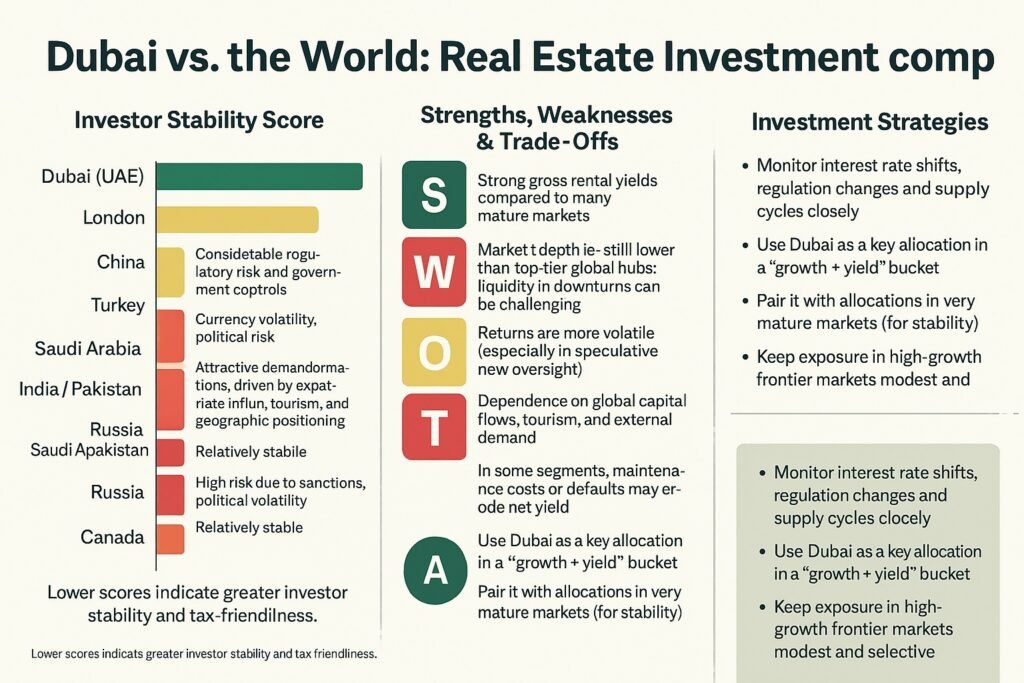
Dubai Leads Global Real Estate Stability (2025)
Lower scores indicate greater investor stability and tax-friendliness.
London (UK)
- Yields: Low to modest (2–4 %) in many central areas
- Price levels / entry cost: very high
- Growth: modest, but stable
- Tax & cost: high stamp duty, capital gains, property taxes
- Regulation: mature and transparent
- Liquidity: deep market
- Risks: Brexit/regulation, property taxes, oversupply in some segments
Shanghai / China
- Yields: modest, often suppressed by regulation
- Capital growth: past decades have delivered strong growth, but increasingly regulated
- Ownership: typically leasehold (70 years), subject to government rules
- Risks: macro control, restrictions on foreign ownership, abrupt policy moves
Tokyo (Japan)
- Yields: modest but stable
- Growth: slow but predictable
- Regulation: strong legal protections
- Risks: demographic decline, slow growth
Singapore
- Yields: modest, sometimes under 3 %
- Growth: moderate, stable
- Regulation: strict, transparent
- Costs: high taxes and transaction costs
- Risks: regulatory changes, limited upside
Turkey (Istanbul, etc.)
- Yields: moderate
- Growth: inflation-driven nominal growth, but real growth is volatile
- Risks: currency devaluation, political risks
Saudi Arabia (Riyadh, NEOM, etc.)
- Yields / growth potential: high upside if the development plans and reforms succeed
- Regulatory environment: evolving; foreign ownership rules changing
- Risks: emerging market vulnerabilities, policy risk
India (Mumbai, Delhi, etc.)
- Yields: variable; often good in secondary or suburban zones
- Growth: high potential in growing cities
- Risks: regulatory risk, land/title disputes, infrastructure gaps
Pakistan (Karachi, Lahore, etc.)
- Yields: potentially high in local markets
- Risks: political uncertainty, currency risk, weak property rights in some areas
Russia (Moscow, St. Petersburg)
- Yields: moderate in prime locations
- Risks: sanctions, political risk, liquidity constraints
Canada (Toronto, Vancouver)
- Yields: relatively low (2–4 %)
- Growth: steady, but affordability constraints
- Regulation: high taxes, property transfer costs
- Stability: high
When comparing all of these with Dubai, you’ll often find that Dubai occupies a kind of “sweet spot” of relatively high yields, favorable tax and cost environment, moderate growth potential, and relatively lower regulatory friction compared to many emerging markets.
Strengths, Weaknesses & Trade-Offs
Where Dubai Leads:
- Strong gross rental yields compared to many mature markets
- Very favorable tax and regulatory environment (no property / capital gains tax for many investors)
- Reasonable entry costs (relative to ultra-premium global cities)
- Attractive demand fundamentals driven by expatriate influx, tourism, and geographic positioning
- Ease of foreign ownership (in freehold zones) and evolving transparency
Where Dubai Lags or Carries Risks:
- Market depth is still lower than top-tier global hubs; liquidity in downturns can be challenging
- Returns are more volatile (especially in speculative segments)
- Regulatory changes are possible (e.g. rental caps, new oversight)
- Dependence on global capital flows, tourism, and external demand
- In some segments, maintenance costs or defaults may erode net yield
- Financing options and mortgage depth for foreigners may lag more mature markets
Which Type of Investor Benefits Most:
- Yield-seeking investors who want high cash flow may favor Dubai over many mature markets
- Growth/inflation hedgers who believe in the UAE’s continued trajectory
- Investors looking for tax-efficient jurisdictions
- Those willing to accept moderate liquidity risk and market volatility
By contrast, ultra risk-averse investors might still prefer fully mature, deep markets like London, Singapore or Tokyo for their stability and established legal/regulatory frameworks, even at the expense of lower yields.
A combined strategy might allocate a base in stable markets for safety and some allocation to Dubai (or other emerging/high-yield markets) for enhanced return potential.
SWOT Analysis – Dubai Real Estate Market (2025)
Hover any point to view detailed insights.
This chart gives a visual summary of how Dubai’s property market performs in different areas that matter to investors — like rental returns, taxes, ownership rights, market stability, and risks.
Each point on the chart represents one key factor, and the score (from 0 to 10) shows how strong or weak Dubai is in that area.
The green shape shows where Dubai is strong or full of opportunity, while the red shape highlights its weaker areas or potential risks.
When the green area is larger than the red, it means the advantages outweigh the drawbacks — which is currently the case for Dubai in 2025.
Conclusion & Recommendations
Conclusion: Dubai’s Position in the Global Property Market (2025)
As of 2025, Dubai stands out as one of the most compelling real estate destinations worldwide.
Its combination of tax-free income, high rental yields, and investor-friendly regulations gives it a stronger risk–return balance than many traditional property hubs.
In fact, Dubai frequently outperforms mature cities such as London, Singapore, and major North American markets in terms of yield, while maintaining clearer regulations and smoother investment processes than most emerging economies.
That said, Dubai is not without risks.
Investors should remain mindful of market cycles, potential oversupply, regulatory adjustments, and broader global factors such as interest rates and economic shifts.
Prudent diversification remains essential to long-term success.
Strategic Takeaways for Investors
Limit exposure in higher-risk frontier markets, using them selectively to capture potential upside without compromising stability.
Stay alert to changes in interest rates, new property regulations, and shifts in supply–demand trends.
Position Dubai as a core part of your “growth + yield” investment portfolio — a market that delivers strong returns without excessive complexity.
Balance your portfolio by pairing Dubai with stable, mature markets for steady performance during global fluctuations.